Pakistan–America–Iran Triangle: Struggling for Peace and Power Balance.
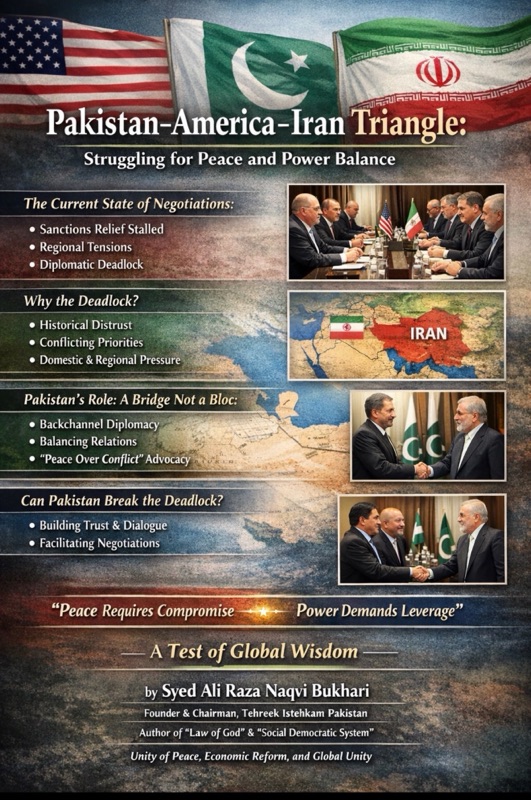
Pakistan–America–Iran Triangle: Struggling for Peace and Power Balance
Introduction
In a rapidly shifting global order, the triangular relationship between Pakistan, the United States, and Iran has emerged as one of the most delicate and consequential geopolitical dynamics. While tensions between Washington and Tehran continue to define regional instability, Pakistan finds itself uniquely positioned—not as a bystander, but as a potential mediator striving to transform conflict into cooperation.
The Current State of Negotiations
Recent diplomatic engagements between the United States and Iran reached a critical yet fragile phase. Initial discussions showed cautious optimism, particularly around sanctions relief and regional de-escalation. However, progress stalled before any comprehensive agreement could be finalized.
The core disagreements remain unresolved:
- The sequencing of sanctions removal
- Iran’s regional strategic posture
- Security guarantees demanded by both sides
This has resulted in a temporary diplomatic deadlock, rather than a complete breakdown.
Why the Deadlock Occurred
The reasons behind the impasse are complex and deeply rooted:
- Historical Distrust
Decades of hostility since the Iranian Revolution continue to shape perceptions and limit flexibility. - Conflicting Strategic Priorities
The United States seeks to contain Iran’s regional influence, while Iran views its policies as essential for sovereignty and defense. - Domestic Political Pressures
Leadership in both countries faces internal resistance, making compromise politically risky. - Regional Power Dynamics
Middle Eastern allies of the United States remain cautious about any agreement that may empower Iran.
Pakistan’s Strategic Role: A Bridge, Not a Bloc
Pakistan’s role in this triangle is neither accidental nor passive. Positioned at the crossroads of South Asia, the Middle East, and Central Asia, Pakistan carries both geographic and diplomatic weight.
Key elements of Pakistan’s role include:
- Backchannel Diplomacy
Quiet engagements aimed at reducing misunderstandings between Tehran and Washington. - Balancing Relations
Maintaining strategic ties with the United States while preserving neighborly and historical relations with Iran. - Advocacy for Peace
Pakistan has consistently emphasized that lasting stability cannot be achieved through conflict, but through dialogue.
This approach reflects a broader vision: transforming Pakistan into a connector of regions rather than a participant in rival blocs.
The United States’ Position
The United States continues to pursue a dual-track strategy—diplomacy combined with pressure. Statements from leaders such as Kamala Harris highlight this approach:
- Willingness to continue negotiations
- Commitment to protecting allies and strategic interests
- Retention of leverage through sanctions and political pressure
Washington’s challenge lies in achieving a deal without appearing to concede strategic ground.
Iran’s Perspective
Iran, on the other hand, seeks recognition of its sovereignty and removal of economic constraints:
- Immediate or phased lifting of sanctions
- Respect for its regional role
- Security assurances against external threats
From Tehran’s viewpoint, negotiations must deliver tangible economic relief, not just political promises.
Peace vs Power: The Core Dilemma
At the heart of this triangle lies a fundamental contradiction:
- Peace requires compromise
- Power demands leverage
The United States uses sanctions as leverage.
Iran uses regional influence as leverage.
Pakistan, however, offers something different—credibility as a neutral facilitator.
Can Pakistan Break the Deadlock?
Pakistan’s potential lies in its ability to:
- Build trust where distrust dominates
- Offer neutral ground for dialogue
- Reframe the narrative from confrontation to cooperation
While Pakistan alone cannot impose a solution, it can enable conditions where a solution becomes possible.
Conclusion: A Test of Global Wisdom
The Pakistan–America–Iran triangle is not merely a geopolitical arrangement—it is a test of whether the modern world can prioritize peace over power.
If diplomacy succeeds, it will redefine regional stability.
If it fails, the consequences will extend far beyond borders.
In this struggle, Pakistan stands at a pivotal point—not as a superpower, but as a peace power.
Author
Syed Ali Raza Naqvi Bukhari
Unity of Peace, Economic Reform, and Global Unity
Founder & Chairman of Tehreek Istehkam Pakistan, and the author of “Law of God” and “Social Democratic System.” advocates for truth, social justice, and reform in all sectors of society.


Comments
Post a Comment