168 Minab: A Silent Chronicle of Injustice.
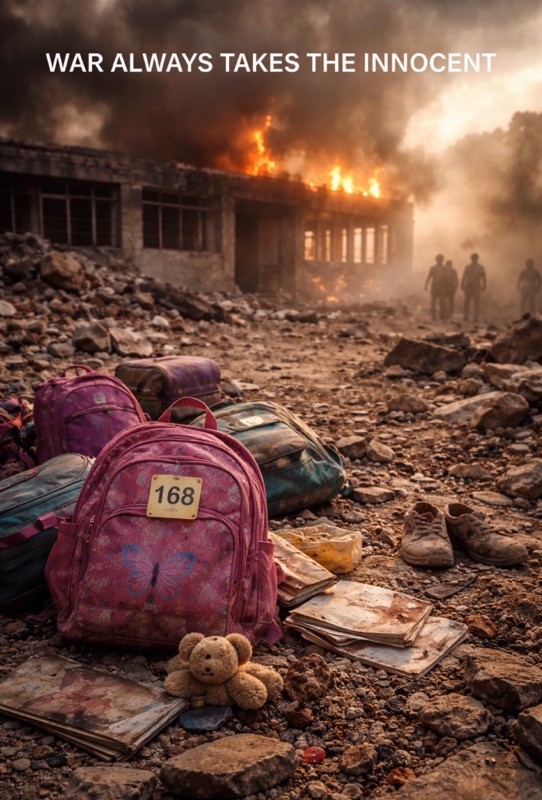
168 Minab: A Silent Chronicle of Injustice
In an age where global powers claim to uphold human rights and international law, the tragic events in Minab have exposed a painful contradiction. The killing of 168 innocent schoolgirls is not merely an incident—it is a haunting reminder of how fragile justice becomes when overshadowed by power.
The Day Innocence Was Shattered
On a quiet day in Minab, a girls’ school became the epicenter of devastation. Reports indicate that advanced cruise missiles—widely associated with modern warfare capabilities such as the Tomahawk missile—struck near or on a civilian educational facility.
What followed was not just destruction of infrastructure, but the silencing of dreams:
- 168 young girls lost their lives
- Classrooms turned into ruins
- Books and schoolbags scattered among debris
Each number represents a story unfinished—a future denied.
More Than Casualties: A Human Tragedy
These were not statistics. These were daughters, students, and symbols of hope. Their schoolbags, later carried across borders, became powerful metaphors of:
- Unfulfilled ambitions
- Interrupted education
- A generation scarred by conflict
The tragedy raised serious questions under the principles of International Humanitarian Law, which strictly prohibit targeting civilians—especially children and schools.
Iran’s Silent Protest: A Message Beyond Words
In a deeply symbolic act, when an Iranian delegation traveled to Pakistan, they carried with them the schoolbags of the martyred girls.
Inside the aircraft:
- The bags of the 168 victims were placed with care
- Their photographs were displayed
- Silence spoke louder than any speech
This was not diplomacy in its conventional sense—it was a moral statement.
A silent protest that conveyed:
“These were not targets. These were children.”
Why This Protest Matters
Iran’s gesture was not just about grief—it was about accountability.
It aimed to:
- Awaken the global conscience
- Remind the world of the human cost of modern warfare
- Urge nations like Pakistan to play a role in restoring justice and peace
In a world desensitized by numbers, this act restored the human face of tragedy.
War vs. Peace: A Defining Question
This incident forces humanity to confront a difficult truth:
Winning wars does not define success—preventing the loss of innocent lives does.
The tragedy of Minab is not just Iran’s pain. It is a test for the entire world:
- Will justice prevail over power?
- Will children remain collateral damage?
- Or will humanity rise above politics?
Conclusion: A Call for Conscience
“168 Minab” is not just a title—it is a symbol.
A symbol of:
- Innocence lost
- Silence that speaks
- And a world that must decide between indifference and justice
If the international community fails to respond with sincerity and accountability, then tragedies like Minab will not be the last.
And the schoolbags of children will continue to travel—not to classrooms, but as evidence of humanity’s failure.
Syed Ali Raza Naqvi Bukhari
Unity of Peace, Economic Reform, and Global Unity
Founder & Chairman of Tehreek Istehkam Pakistan, and the author of “Law of God” and “Social Democratic System.” advocates for truth, social justice, and reform in all sectors of society.


Comments
Post a Comment