The U.S., Israel, and Iran: Nuclear Non-Proliferation or a Strategy to Weaken Islamic States?
Just for explanation
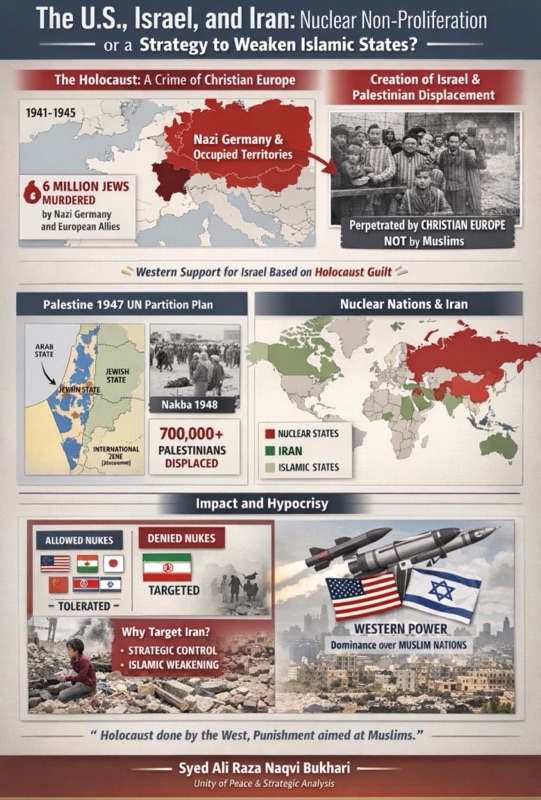
The U.S., Israel, and Iran: Nuclear Non-Proliferation or a Strategy to Weaken Islamic States?
The ongoing geopolitical tensions involving Iran, Israel, and the United States are often framed as measures to prevent nuclear proliferation. However, historical and political analysis suggests that the core motive may not be global security but strategic containment of Islamic nations. The narrative surrounding Israel’s security and Western support is deeply intertwined with historical events, particularly the Holocaust, which was perpetrated by European Christian powers, not Muslims.
Historical Context: The Holocaust and Its Aftermath
Between 1941 and 1945, Nazi Germany, led by Adolf Hitler, systematically murdered approximately six million Jews, alongside millions of others, including Roma, disabled individuals, and political opponents. This genocide, known as the Holocaust, was orchestrated by Germany and its European allies, reflecting anti-Semitism in European Christian societies at the time.
- Muslims were not responsible for the Holocaust.
- The global Jewish community’s suffering during this period became a major factor in the international support for the creation of Israel in 1948.
- Many historical accounts and political narratives, however, often conflate contemporary Middle East conflicts with the Holocaust, creating the impression that Islamic nations are collectively responsible—a historically false and misleading claim.
Israel’s Establishment and Western Support
Israel was founded on lands historically belonging to Palestinians. While it is internationally recognized today, the establishment of Israel resulted in the displacement of millions of Palestinians during the Nakba (Catastrophe).
- The Holocaust provided a moral and political justification for Western powers to strongly support Israel.
- The U.S. and European countries often prioritize Israel’s security over international law or Palestinian rights.
This dynamic creates a perception of a double standard, especially when Islamic nations are subjected to restrictions and threats over nuclear programs while Israel’s own capabilities are largely unquestioned.
Iran, Nuclear Programs, and the Double Standard
Iran’s nuclear program is often portrayed as a threat to global security. Yet, countries like India, China, and North Korea developed nuclear capabilities with far less immediate threat of invasion or preemptive strikes.
Key points:
- Historical and religious bias
- Western narratives emphasize the Holocaust and Israel’s security as a moral imperative, while Iran and other Islamic countries face disproportionate scrutiny.
- Strategic motives
- Preventing Islamic countries from achieving nuclear parity ensures continued geopolitical dominance of the U.S., Israel, and their allies in the Middle East.
- Ethical implications
- Civilians in Gaza and conflict zones bear the brunt of military actions.
- These actions are often justified in the name of security, while the historical truth is distorted: the Holocaust was not committed by Muslims, yet Islamic countries face collective pressure and narratives of threat.
Geopolitical Implications
- The perception that nuclear non-proliferation is applied selectively fuels anger in Muslim-majority countries.
- Pakistan’s nuclear program, for example, serves as a deterrent, preventing potential aggression in a region where Islamic nations are disproportionately scrutinized.
- The imbalance between Israel’s security privileges and the threats faced by Islamic nations illustrates a power-driven double standard in global politics.
Conclusion
The international focus on Iran’s nuclear ambitions is often framed as a matter of global security, yet a closer look reveals:
- The historical trauma of the Holocaust, caused by European Christian powers, is used to justify Israeli security and influence.
- Islamic nations face disproportionate pressure, creating a double standard in nuclear policy.
- The real concern is strategic control, not purely non-proliferation.
This selective application of moral and legal principles highlights the intersection of history, religion, power, and politics, demonstrating how global narratives can obscure truth while amplifying geopolitical agendas.
Syed Ali Raza Naqvi Bukhari
Unity of Peace, Economic Reform, and Global Unity
Founder & Chairman of Tehreek Istehkam Pakistan, and the author of “Law of God” and “Social Democratic System.” Advocates for truth, social justice, and reform in all sectors of society.


Comments
Post a Comment