Pakistan’s Image Is Not a Political Weapon
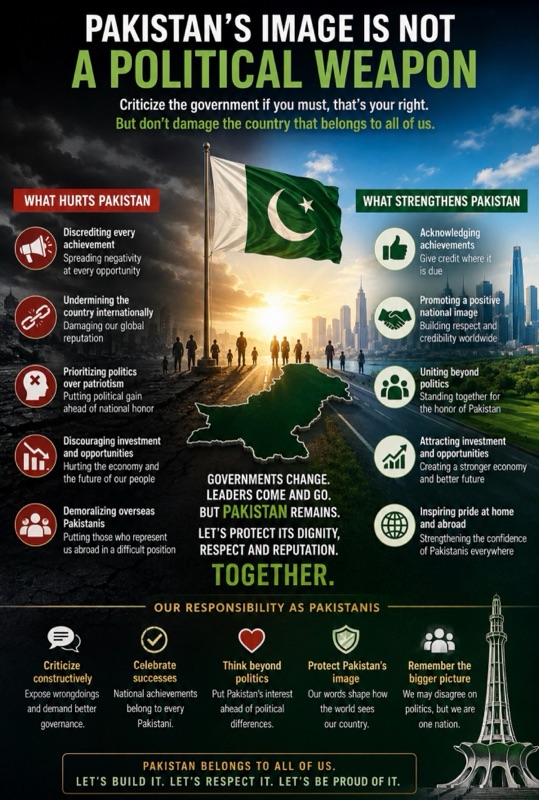 Pakistan’s Image Is Not a Political Weapon
Introduction: A Nation Above Politics
Every democratic society thrives on debate, criticism, and accountability. Citizens have the right—and indeed the responsibility—to question governments, challenge policies, and demand better performance from those in power. However, there is a crucial difference between criticizing a government and undermining the reputation of an entire nation.
Unfortunately, in today’s highly polarized political environment, some individuals appear willing to sacrifice Pakistan’s international image in pursuit of domestic political objectives. In doing so, they risk harming the very country they claim to serve.
The Difference Between Government and Country
Governments are temporary institutions. Political parties rise and fall, leaders come and go, and policies change with time. Nations, however, endure.
Pakistan is not any single government, political party, or individual. It is a sovereign nation of more than 250 million people, with a rich history, resilient citizens, and immense potential.
When criticism of a government transforms into an attack on the credibility of Pakistan itself, the line between political opposition and national responsibility begins to disappear.
The Cost of Damaging Pakistan’s International Reputation
In today’s interconnected world, a nation’s image has real consequences.
International investors assess political stability and public confidence before committing capital. Foreign governments consider reputation when strengthening diplomatic and economic partnerships. International organizations evaluate credibility when extending support and cooperation.
When influential voices repeatedly portray Pakistan as corrupt, dishonest, unstable, or incapable of progress, they contribute to a narrative that can discourage investment, reduce opportunities, and weaken the country’s standing in the global arena.
The damage is not limited to any government; it affects every Pakistani citizen.
Why National Achievements Deserve Recognition
No nation progresses without achievements worth celebrating.
Whether it is economic recovery, successful diplomacy, humanitarian assistance, technological innovation, infrastructure development, scientific advancement, or international recognition, positive accomplishments should be acknowledged on their merits.
Recognizing a national achievement does not mean surrendering one’s political beliefs. It does not require supporting a particular government or political party. It simply reflects intellectual honesty and national maturity.
A country cannot move forward if every success is denied, dismissed, or discredited for political reasons.
Constructive Criticism Strengthens Nations
Criticism is not the problem. Irresponsible criticism is.
Healthy democracies depend on citizens who expose corruption, identify weaknesses, and advocate reforms. Constructive criticism helps governments improve and strengthens national institutions.
However, criticism becomes destructive when it seeks not to improve the country but to convince the world that the country is incapable of improvement.
The objective should always be reform, not ridicule; progress, not sabotage.
The Responsibility of Public Figures and Influencers
Public figures, political leaders, journalists, activists, and social media influencers carry significant responsibility.
Their words shape public opinion at home and influence perceptions abroad. Statements made on international platforms are often interpreted as reflections of the nation’s condition.
Responsible leadership requires balance: speaking honestly about challenges while also acknowledging achievements and opportunities.
A nation cannot build confidence internationally if its own citizens consistently undermine it before the world.
How Other Nations Protect Their National Interest
Across the world, political rivals often engage in fierce domestic debates. Yet when national interests are at stake, many set aside partisan differences to protect their country’s reputation.
They may criticize their governments vigorously at home, but they do not actively campaign to discredit their nation before international audiences.
This distinction reflects political maturity and a shared understanding that national prestige is a strategic asset.
Pakistan deserves the same level of responsibility from its citizens and leaders.
Overseas Pakistanis and National Pride
Millions of Pakistanis live, work, and study abroad. They serve as ambassadors of Pakistan’s culture, values, and capabilities.
When negative and exaggerated portrayals dominate international discussions, overseas Pakistanis often face the consequences firsthand. They are forced to defend the image of a country they proudly represent.
These Pakistanis deserve support from their fellow citizens, not narratives that unnecessarily damage the reputation of their homeland.
Patriotism Requires Balance
Patriotism does not mean blind loyalty to any government. It does not require silence in the face of mistakes, corruption, or poor governance.
Likewise, patriotism does not mean rejecting every positive development simply because it occurred under a political opponent.
True patriotism demands balance—the courage to criticize what is wrong and the integrity to acknowledge what is right.
A mature society can hold both ideas simultaneously.
Pakistan’s Future Depends on Unity of Purpose
Pakistan faces many challenges, but it also possesses extraordinary strengths: a young population, entrepreneurial talent, strategic importance, natural resources, and a resilient spirit.
Building a stronger future requires constructive debate, institutional reform, economic growth, and national confidence.
Political competition should never come at the expense of Pakistan’s global standing. The country’s reputation is a national asset that belongs to every citizen, regardless of political affiliation.
Conclusion: Protect the Nation, Debate the Politics
Citizens have every right to disagree with governments, challenge policies, and demand accountability. These are essential features of a democratic society.
But there is a profound difference between opposing a government and damaging the image of a nation.
Pakistan belongs to all of us. Its successes should be celebrated, its shortcomings should be addressed, and its dignity should be protected.
Political differences are temporary. National honor is permanent.
We may stand on different sides of the political spectrum, but when it comes to Pakistan’s reputation before the world, we should stand together.


Comments
Post a Comment