Who Should Host the Next U.S.–Iran Negotiations? A Strategic Debate for the Future of the Middle East.
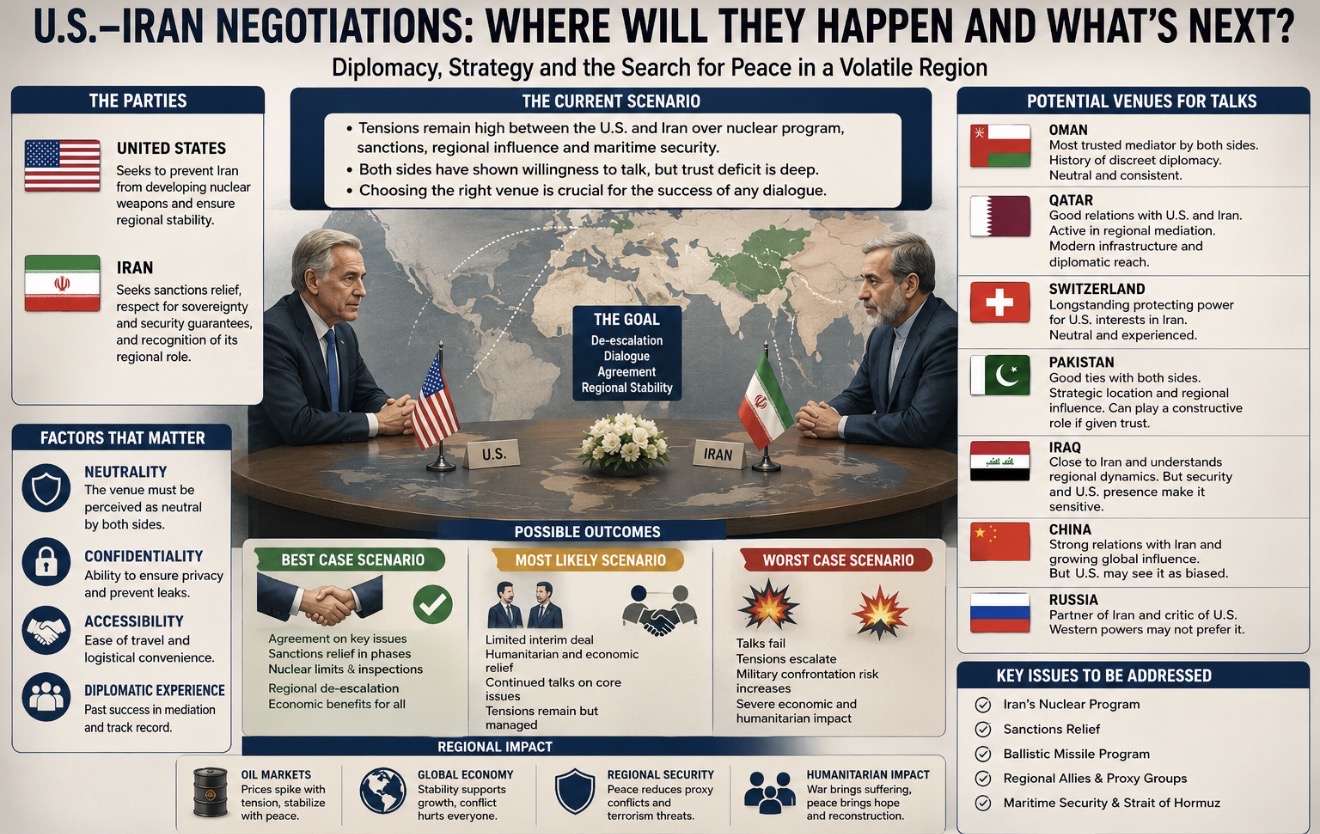
Who Should Host the Next U.S.–Iran Negotiations? A Strategic Debate for the Future of the Middle East.
The continuing tensions between the United States and Iran have once again placed the Middle East at the center of global diplomacy. After military escalation, economic pressure, and regional uncertainty, the possibility of renewed negotiations has created cautious optimism across the world. However, one important question has emerged alongside the diplomatic efforts:
Which country should host the next U.S.–Iran negotiations?
This debate is not merely about geography or protocol. The choice of host country reflects trust, strategic influence, neutrality, regional balance, and international credibility. Every potential host carries political symbolism and strategic consequences.
Some experts argue that Oman remains the safest and most trusted diplomatic bridge between Washington and Tehran. Others believe Qatar’s growing regional influence makes it the ideal platform. Some analysts advocate for Pakistan as a rising mediator capable of bridging the Muslim world with global powers. Meanwhile, countries such as Switzerland, China, and even Iraq are also discussed in diplomatic circles.
This debate has become increasingly important because the success or failure of future negotiations could determine the stability of the Middle East for years to come.
Why the Host Country Matters
The host nation of sensitive negotiations plays several critical roles:
- Providing security and confidentiality.
- Building trust between hostile parties.
- Facilitating indirect communication.
- Reducing diplomatic pressure.
- Offering political neutrality.
- Preventing media manipulation and external interference.
Historically, peace talks succeed more effectively when both parties trust the mediator or host. Therefore, the selection of the next venue for U.S.–Iran negotiations is itself a strategic decision.
Oman: The Traditional and Trusted Mediator
Arguments in Favor of Oman
Oman has long maintained a reputation as one of the most neutral countries in the Middle East. Unlike many regional powers, Oman traditionally avoids aggressive regional rivalries and prefers quiet diplomacy.
For years, Oman has served as a discreet communication channel between the United States and Iran. Several earlier negotiations, including discussions connected to the Iran nuclear agreement, benefited from Omani mediation.
Supporters of Oman argue that:
- Both Tehran and Washington trust Oman.
- Oman avoids media sensationalism.
- The country maintains balanced relations with all Gulf states.
- Omani diplomacy focuses on stability rather than political influence.
- Its leadership has earned international respect for calm and balanced diplomacy.
From Iran’s perspective, Oman is considered safer because it does not openly align itself against Tehran. From the American perspective, Oman remains cooperative and reliable.
Criticism of Oman
Despite these advantages, critics argue that Oman’s diplomatic influence is limited compared to larger regional powers. Some analysts believe that while Oman can facilitate talks, it lacks the geopolitical weight necessary to enforce or sustain major regional agreements.
Others argue that the modern Middle East requires more active and powerful mediators capable of influencing broader regional dynamics.
Qatar: The Emerging Diplomatic Power
Arguments in Favor of Qatar
Over the last decade, Qatar has transformed itself into a major diplomatic actor in international conflicts. From Afghanistan negotiations to regional mediation efforts, Qatar has invested heavily in becoming a center of global diplomacy.
Qatar maintains strong relations with:
- The United States,
- Iran,
- Turkey,
- Various regional political movements,
- And Western allies.
Supporters believe Qatar offers:
- Modern diplomatic infrastructure,
- Strong security capabilities,
- Significant global influence,
- Access to American policymakers,
- And active regional engagement.
Qatar also hosts important American military facilities, making communication with Washington easier.
Criticism of Qatar
Critics argue that Qatar’s deep strategic partnership with the United States may create distrust inside Iran. Some regional actors also accuse Qatar of pursuing an overly ambitious foreign policy designed to expand its own influence.
Additionally, opponents argue that Qatar’s visibility and media exposure could make sensitive negotiations more politically complicated.
Pakistan: A Potential Bridge Between Worlds
Arguments in Favor of Pakistan
Pakistan presents an interesting and increasingly discussed option.
As a nuclear power, a major Muslim country, and a state maintaining relations with both the United States and Iran, Pakistan possesses unique strategic relevance.
Supporters of Pakistan argue:
- Pakistan understands both Western and Islamic political dynamics.
- It shares a border and historical ties with Iran.
- Pakistan has longstanding relations with Gulf countries.
- China’s strategic partnership with Pakistan increases its geopolitical significance.
- Pakistan’s military and diplomatic institutions possess regional experience.
Some analysts believe Pakistan could become a symbol of Islamic diplomatic unity if it successfully facilitates regional peace.
Pakistan’s role could also strengthen its international image as a responsible regional power focused on stability and dialogue.
Criticism of Pakistan
However, critics argue that Pakistan currently faces several internal challenges:
- Political instability,
- Economic pressures,
- Security concerns,
- And complex regional balancing.
Some American policymakers may also worry about Pakistan’s close relationship with China.
At the same time, certain Iranian circles may question whether Pakistan can maintain strict neutrality under pressure from competing regional interests.
As a result, while Pakistan has potential, many experts believe it may not yet be the first choice for immediate negotiations.
Switzerland: The Quiet Diplomatic Channel
Arguments in Favor of Switzerland
Switzerland has historically represented neutrality in global diplomacy.
For decades, Switzerland has acted as a communication channel between the United States and Iran, particularly during periods when formal diplomatic relations were absent.
Advantages include:
- International trust,
- Diplomatic professionalism,
- Political neutrality,
- High security,
- And confidentiality.
Criticism of Switzerland
Critics argue that Switzerland is geographically and politically distant from the realities of the Middle East. While it may provide a technically neutral venue, it lacks direct regional influence.
Some believe that Middle Eastern conflicts increasingly require regional solutions rather than purely Western diplomatic platforms.
China and Russia: Strategic but Controversial Options
Arguments in Favor
China and Russia maintain close strategic relations with Iran and possess increasing global influence.
China especially has emerged as an economic and diplomatic power capable of influencing regional affairs. Beijing’s successful role in restoring relations between Saudi Arabia and Iran increased international attention toward Chinese diplomacy.
Russia, meanwhile, maintains extensive regional military and political connections.
Criticism
However, the United States may strongly resist negotiations hosted by China or Russia because of broader geopolitical competition.
Many analysts believe that negotiations hosted by either country could become entangled in global power struggles rather than remaining focused solely on U.S.–Iran relations.
Iraq: Symbolically Important but Risky
Iraq shares deep political, religious, and economic ties with Iran while also maintaining important relations with the United States.
Some argue that Baghdad could symbolize regional ownership of peace efforts.
However, Iraq faces:
- Security concerns,
- Internal political divisions,
- Militia influence,
- And ongoing geopolitical pressure.
These realities make Iraq a highly sensitive and risky option for major negotiations.
The Broader Regional Impact
The country chosen to host negotiations will influence more than diplomacy between Washington and Tehran.
It could shape:
- Gulf security,
- Energy markets,
- Regional alliances,
- Israel–Iran tensions,
- The future of nuclear negotiations,
- Maritime security in the Strait of Hormuz,
- And the political future of the wider Middle East.
A successful negotiation venue could also elevate the international status of the host country itself.
The Most Likely Scenario
Based on current diplomatic trends, Oman appears to remain the strongest and most realistic option for near-term negotiations.
Its neutrality, diplomatic experience, and trusted relationship with both sides make it the safest choice during a period of high tension.
Qatar remains a strong alternative due to its rising diplomatic profile and strategic importance.
Pakistan could emerge as a future mediator if regional diplomacy expands and if broader Islamic cooperation strengthens.
Meanwhile, Switzerland may continue to play an important background communication role.
Conclusion
The debate over where the next U.S.–Iran negotiations should take place reflects the changing political landscape of the modern world.
The Middle East is no longer shaped solely by military power. Diplomacy, strategic balance, economic pressure, and regional partnerships now play equally important roles.
The host country for future negotiations will symbolize more than diplomatic convenience. It will represent trust, influence, neutrality, and the future direction of international diplomacy in one of the world’s most sensitive regions.
Whether the talks occur in Oman, Qatar, Pakistan, Switzerland, or elsewhere, the ultimate goal should remain the same:
Preventing further conflict, protecting regional stability, and creating a path toward peaceful coexistence.
Only through dialogue, wisdom, and balanced diplomacy can lasting peace become possible in the Middle East.
Syed Ali Raza Naqvi Bukhari
Unity of Peace, Economic Reform, and Global Unity
Founder & Chairman of Tehreek Istehkam Pakistan, and the author of “Law of God” and “Social Democratic System.” advocates for truth, social justice, and reform in all sectors of society.


Comments
Post a Comment