The Middle East at a Turning Point: War, Diplomacy, and the Future of the Muslim World.
Picture AI Generate
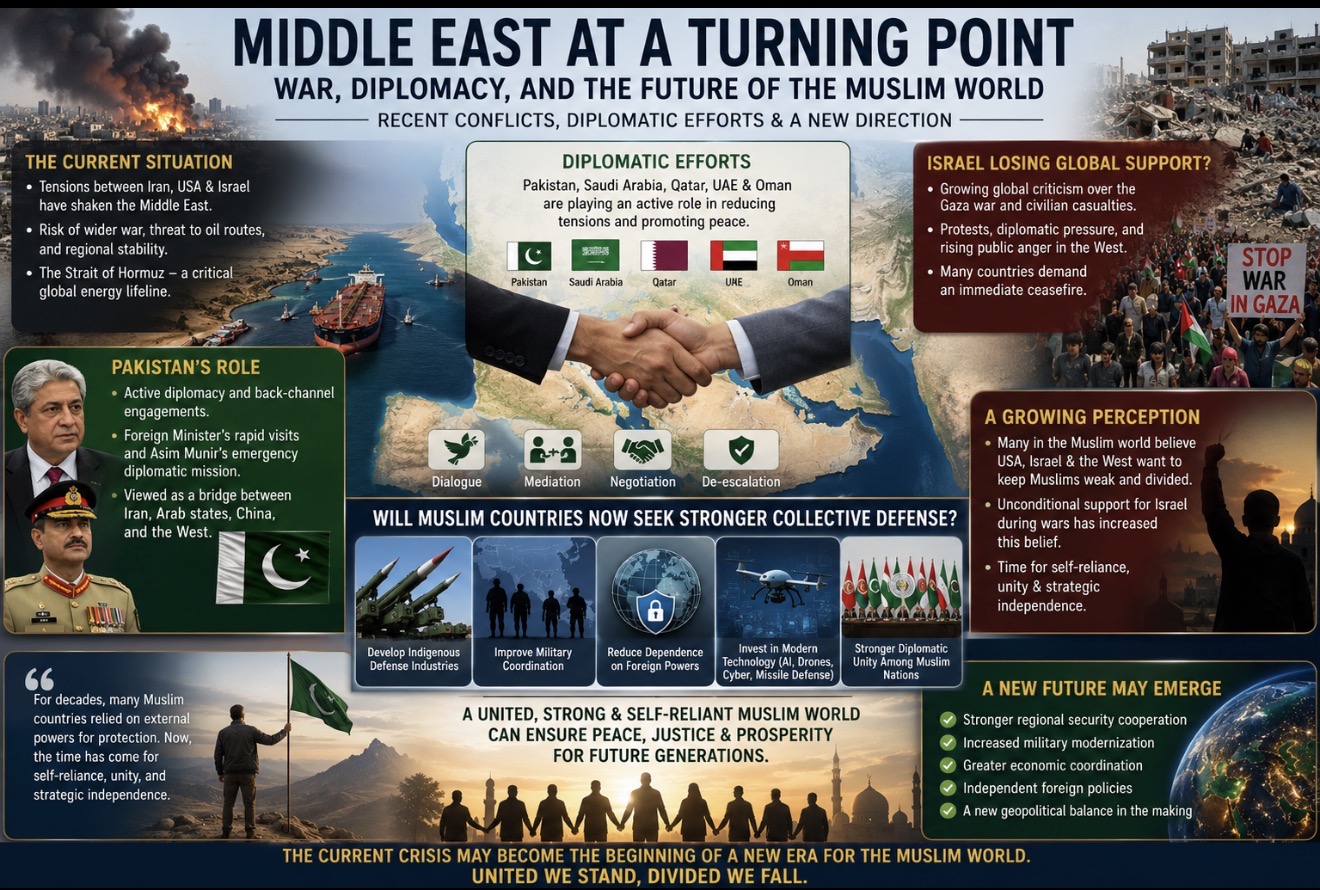
The Middle East at a Turning Point: War, Diplomacy, and the Future of the Muslim World
The Middle East is once again standing at a historic crossroads. The recent escalation involving Iran, the United States, and Israel has shaken the political, economic, and security structure of the entire region. What initially appeared to be another limited confrontation gradually evolved into a wider geopolitical crisis involving Gulf states, global energy routes, and the future balance of power in the Muslim world.
In recent weeks, intense diplomatic activity by Pakistan, Saudi Arabia, Qatar, the UAE, and Oman has signaled a serious regional effort to prevent a catastrophic war. Pakistan’s Foreign Minister Ishaq Dar conducted rapid diplomatic engagements, while Pakistan’s military leadership, including Field Marshal Asim Munir, held emergency-level consultations with Iranian officials in Tehran. Qatar and Oman have also been deeply involved in mediation efforts aimed at reopening dialogue between Tehran and Washington.
At the center of the crisis lies not only the Iran–US conflict but also the broader fear that continued instability could destroy regional economies, threaten oil routes, and ignite a larger sectarian and geopolitical confrontation. The Strait of Hormuz — through which a major percentage of the world’s oil passes — became one of the most sensitive flashpoints of the conflict. Reports suggest that negotiations over reopening and stabilizing the strait are now a critical part of ongoing diplomatic talks.
However, beyond the battlefield and diplomacy, another important question is emerging across the Muslim world:
Will Muslim Countries Now Seek Stronger Collective Defense?
The recent conflict exposed a harsh reality for many Muslim-majority countries: despite possessing vast natural resources and strategic geography, much of the Islamic world remains militarily dependent on external powers for advanced defense systems, intelligence networks, and strategic security guarantees.
Several Gulf countries reportedly faced missile and drone attacks during the confrontation, forcing them to reassess their long-term security strategies. Analysts have argued that the war permanently changed the Gulf states’ “security calculus.”
This has strengthened discussions within many Muslim societies about:
- developing indigenous defense industries,
- improving regional military coordination,
- reducing strategic dependence on foreign powers,
- investing in missile defense systems, cybersecurity, drones, and AI-based warfare,
- and creating stronger diplomatic unity among Muslim nations.
A growing perception also exists among many people in the Muslim world that Western powers often prioritize strategic dominance and geopolitical interests over justice, sovereignty, and humanitarian concerns in the region. The unwavering Western military and political support for Israel during conflicts in Gaza and the wider region has intensified this sentiment among millions of Muslims worldwide.
At the same time, it is important to recognize that international politics is driven largely by national interests rather than religion alone. The United States, Europe, Russia, China, Iran, Türkiye, Saudi Arabia, and other regional powers all pursue policies based on security, economics, alliances, and influence. Simplifying the conflict purely into a “West versus Muslims” framework risks overlooking the complex political realities shaping modern geopolitics.
Still, one undeniable consequence of the recent war is the emergence of a stronger desire for strategic independence across the Muslim world.
Pakistan’s Rising Diplomatic Role
Pakistan has unexpectedly emerged as one of the key diplomatic actors in the crisis. International observers increasingly view Islamabad as a bridge capable of communicating with Iran, Gulf Arab states, China, and Western powers simultaneously.
Pakistan’s approach has largely focused on:
- preventing direct regional war,
- protecting Gulf stability,
- avoiding sectarian polarization,
- and encouraging negotiated settlements rather than military escalation.
This balancing role has enhanced Pakistan’s importance in regional diplomacy, particularly as many countries seek neutral intermediaries capable of engaging all sides.
A New Regional Order May Be Emerging
Recent developments suggest that a new geopolitical alignment may gradually be forming in the Muslim world. Strategic cooperation among Pakistan, Saudi Arabia, Türkiye, Qatar, and other regional actors appears to be increasing in response to shifting global power dynamics.
The long-term consequences could include:
- stronger regional security cooperation,
- increased military modernization,
- greater economic coordination,
- and a more independent foreign policy posture among Muslim states.
Whether this evolves into a formal strategic bloc or remains limited cooperation will depend on future leadership, economic stability, and the ability of Muslim countries to overcome internal rivalries.
Conclusion
The current Iran–US–Israel crisis may ultimately become more than just another Middle Eastern conflict. It may represent the beginning of a larger transformation in how Muslim nations view security, diplomacy, sovereignty, and global power.
For decades, many Muslim countries relied heavily on external powers for protection and regional stability. Today, after witnessing repeated wars, economic pressure, and geopolitical uncertainty, a growing number of voices across the Islamic world are calling for self-reliance, unity, and strategic independence.
Whether these aspirations lead to meaningful cooperation or remain political rhetoric will shape the future of the Middle East for decades to come.
Syed Ali Raza Naqvi Bukhari
Unity of Peace, Economic Reform, and Global Unity
Founder & Chairman of Tehreek Istehkam Pakistan, and the author of “Law of God” and “Social Democratic System.” advocates for truth, social justice, and reform in all sectors of society.


Comments
Post a Comment