Punjab’s Free Public Transport Initiative: A Bold Step Toward Public Relief and Economic Stability.
Picture just for Reference
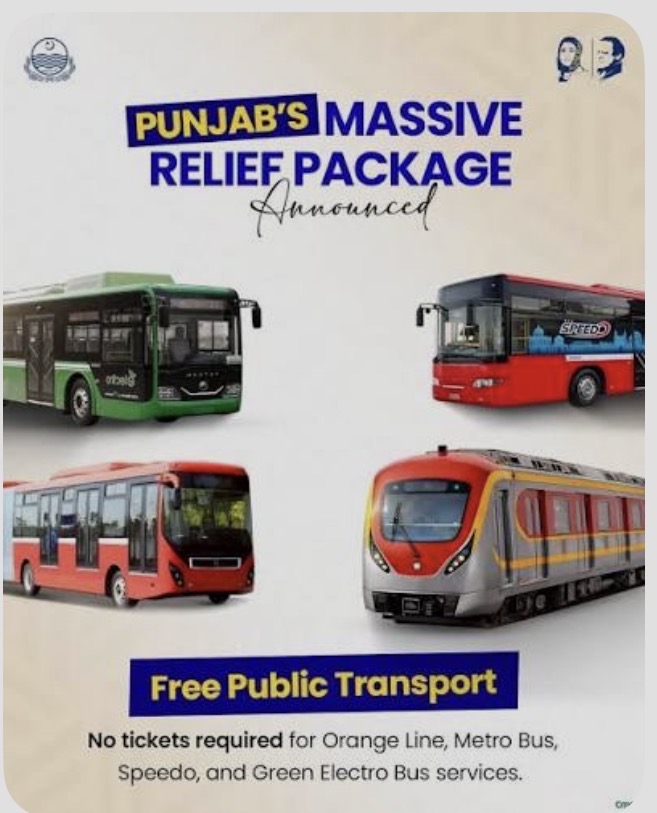 Punjab’s Free Public Transport Initiative: A Bold Step Toward Public Relief and Economic Stability
In a time when inflation, rising fuel prices, and economic uncertainty continue to burden ordinary citizens, the decision by the Government of Punjab to introduce free public transport services stands out as a bold and people-centered initiative. At a moment when many families are struggling to manage daily expenses, reducing transportation costs directly impacts the lives of millions of workers, students, women, and low-income households.
The announcement, made under the leadership of Chief Minister Maryam Nawaz, gained public attention particularly during the period of regional tensions and rising global oil prices linked to the Iran conflict. As fuel prices increased, transportation costs became one of the biggest financial pressures on the public. In such conditions, providing free or highly subsidized public transport was not merely a political decision; it represented an attempt to provide immediate social and economic relief.
A People-Centered Welfare Approach
Transportation is not a luxury; it is a necessity connected to employment, education, healthcare, and economic activity. In developing countries like Pakistan, many citizens spend a significant portion of their income on daily travel. For laborers, students, office workers, and small business employees, transportation costs can become unbearable during periods of inflation.
By making public transport free across major urban routes, the Punjab government demonstrated an understanding of the challenges faced by ordinary people. This policy has the potential to:
- Reduce the financial burden on low- and middle-income families.
- Improve access to schools, colleges, and universities.
- Help workers commute more affordably.
- Encourage the use of public transport over private vehicles.
- Reduce traffic congestion in major cities.
- Lower fuel consumption and environmental pollution.
- Promote social inclusion by helping women, elderly citizens, and vulnerable communities travel safely.
In many developed countries, affordable public transport is considered part of a strong welfare system. European cities such as Luxembourg and Tallinn have experimented successfully with free or highly subsidized public transportation. Their experiences show that investment in public mobility can improve economic productivity, reduce environmental damage, and strengthen social equality.
Why This Initiative Matters for Pakistan
Pakistan is currently facing economic difficulties that include inflation, currency pressure, rising energy costs, unemployment concerns, and increasing urban congestion. In this environment, a public relief initiative of this nature carries significant importance.
The psychological effect of such policies should not be underestimated. When citizens feel that governments are making efforts to ease their hardships, public confidence improves. Free public transport sends a message that governance should not only focus on infrastructure and development projects but also on direct relief for the common citizen.
This initiative also reflects an important shift toward modern urban governance. Around the world, cities are moving toward sustainable transportation systems that prioritize buses, trains, electric vehicles, and environmentally friendly mobility solutions.
If managed effectively, Punjab’s policy could become a model for other provinces and potentially for South Asia as a whole.
Challenges That Must Be Addressed
While the initiative deserves appreciation, long-term success depends on effective planning and sustainable management.
Several challenges must be considered:
1. Financial Sustainability
Providing free transport requires substantial government funding. Without a stable financial model, the system may struggle to continue in the long run.
2. Overcrowding and Infrastructure Pressure
When transportation becomes free, passenger numbers rise significantly. If additional buses and transport capacity are not introduced, overcrowding can reduce service quality.
3. Rural Accessibility
Most public transport systems primarily serve large cities. Rural populations must also benefit from improved and affordable mobility.
4. Service Quality
Free transport should not mean poor transport. Cleanliness, punctuality, safety, and professional management are essential.
5. Corruption and Mismanagement
Public welfare projects often face challenges related to inefficiency and misuse of funds. Transparency and digital monitoring are necessary to maintain public trust.
Recommendations for Further Improvement
To transform this initiative into a sustainable and internationally respected model, several improvements can be considered:
Expand Electric Public Transport
Punjab should continue investing in electric buses and environmentally friendly transport systems. This would reduce fuel imports and improve air quality.
Introduce Smart Digital Cards
A digital transport card system can help manage passengers, reduce misuse, and improve transparency.
Prioritize Students and Workers
Even if universal free transport becomes financially difficult, students, laborers, elderly citizens, and differently abled individuals should continue receiving permanent concessions.
Strengthen Intercity Connectivity
Affordable transport between cities can boost trade, tourism, education, and employment opportunities.
Develop Sustainable Funding Sources
The government can generate funding through:
- Advertising partnerships
- Parking fees in major cities
- Green taxes on pollution-heavy sectors
- Public-private partnerships
- Carbon financing and international climate support programs
Improve Safety for Women
Dedicated safety systems, surveillance, and women-friendly transport policies can encourage greater female participation in education and employment.
Integrate Technology
Mobile applications for schedules, digital payments, tracking systems, and route planning can modernize the entire transport network.
A Vision Beyond Transportation
This initiative should not be viewed only as a transport policy. It can become part of a larger vision for economic reform, environmental sustainability, and social welfare.
A strong public transport system supports:
- Economic growth
- Urban development
- Social equality
- Environmental protection
- National productivity
Countries that invested seriously in public transportation eventually strengthened their economies and improved quality of life for citizens.
Punjab now has an opportunity to lead Pakistan toward a more modern, welfare-oriented, and environmentally conscious future.
The true success of this initiative will depend not only on temporary relief but on whether it evolves into a sustainable public service model based on transparency, efficiency, and long-term planning.
If implemented wisely, this policy could become one of the most impactful public welfare reforms in Pakistan’s recent history.
Syed Ali Raza Naqvi Bukhari
Unity of Peace, Economic Reform, and Global Unity
Founder & Chairman of Tehreek Istehkam Pakistan, and the author of “Law of God” and “Social Democratic System.” advocates for truth, social justice, and reform in all sectors of society.


Comments
Post a Comment