How the Killers of Jesus Became His Heirs.
Picture just for Reference
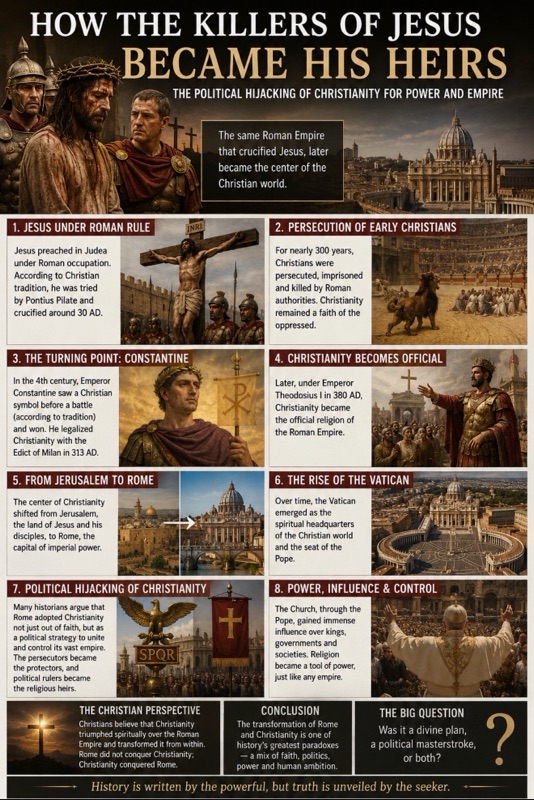
How the Killers of Jesus Became His Heirs
The Political Hijacking of Christianity for Power and Empire
Introduction: From Persecution to Power
History is often shaped not only by faith, but by politics and power. One of the most controversial transformations in human civilization is how the Roman Empire — once accused in Christian tradition of crucifying Jesus — later became the global center of Christianity itself.
Jesus Under Roman Rule
Jesus preached in Judea during the rule of the Roman Empire. According to Christian tradition, his trial and crucifixion occurred under the Roman governor Pontius Pilate.
Early Christians faced persecution, imprisonment, and execution. For centuries, Christianity remained a faith of the oppressed rather than a religion of emperors.
The Sudden Transformation of Rome
The turning point came in the fourth century when Constantine the Great legalized Christianity and granted it imperial support. Later, under Theodosius I, Christianity officially became the religion of the Roman Empire.
This dramatic shift raises a profound historical question:
How did the persecutors of Christianity become its guardians?
Christianity as a Political Strategy
Many historians believe Rome realized that Christianity could no longer be eliminated. The religion was spreading rapidly across the empire and attracting large numbers of followers.
Rather than continue fighting it, the empire absorbed it.
Some scholars argue that Christianity became a tool for political unity during a time of crisis and instability inside the empire. A single organized faith could strengthen imperial authority and unite divided populations.
From Jerusalem to Rome
Originally, the earliest followers of Jesus were centered in Jerusalem and surrounding regions. However, over time the religious center shifted toward Rome — the capital of imperial power.
Eventually, Vatican City emerged as the headquarters of the Roman Catholic Church and the seat of the Pope.
The Rise of the Vatican
The Vatican became not only a religious institution but also a major political force. Throughout medieval history, Popes influenced kings, governments, wars, and international affairs.
Critics argue that this represented a transformation of Christianity from a spiritual movement into an imperial institution closely linked with political authority.
Did Rome Hijack Christianity?
One interpretation of history suggests that Rome effectively “hijacked” Christianity — adopting its name, influence, and growing popularity to preserve imperial control.
In this view:
- The empire that once punished Christians later ruled باسم Christianity.
- Political rulers became religious heirs.
- Imperial authority gained legitimacy through religion.
This theory remains controversial, but it continues to attract attention among political historians and independent thinkers.
The Christian Perspective
Traditional Christian believers see the matter differently. They argue that Christianity triumphed spiritually over the Roman Empire and transformed it from within.
According to this perspective, Rome did not conquer Christianity; Christianity conquered Rome.
Conclusion: Faith, Power, and History
The relationship between Rome and Christianity remains one of the most debated subjects in world history. Whether viewed as divine destiny, political strategy, or a mixture of both, the transformation permanently reshaped civilization.
The empire once associated with the persecution of Jesus eventually became the center of global Christianity — a historical paradox that still raises powerful questions today.
Syed Ali Raza Naqvi Bukhari
Unity of Peace, Economic Reform, and Global Unity
Founder & Chairman of Tehreek Istehkam Pakistan, and the author of “Law of God” and “Social Democratic System.” advocates for truth, social justice, and reform in all sectors of society.


Comments
Post a Comment