Dependence on Others for Defense or Strategic Self-Reliance: Muslim Nations Must Decide.
Picture AI Genrated
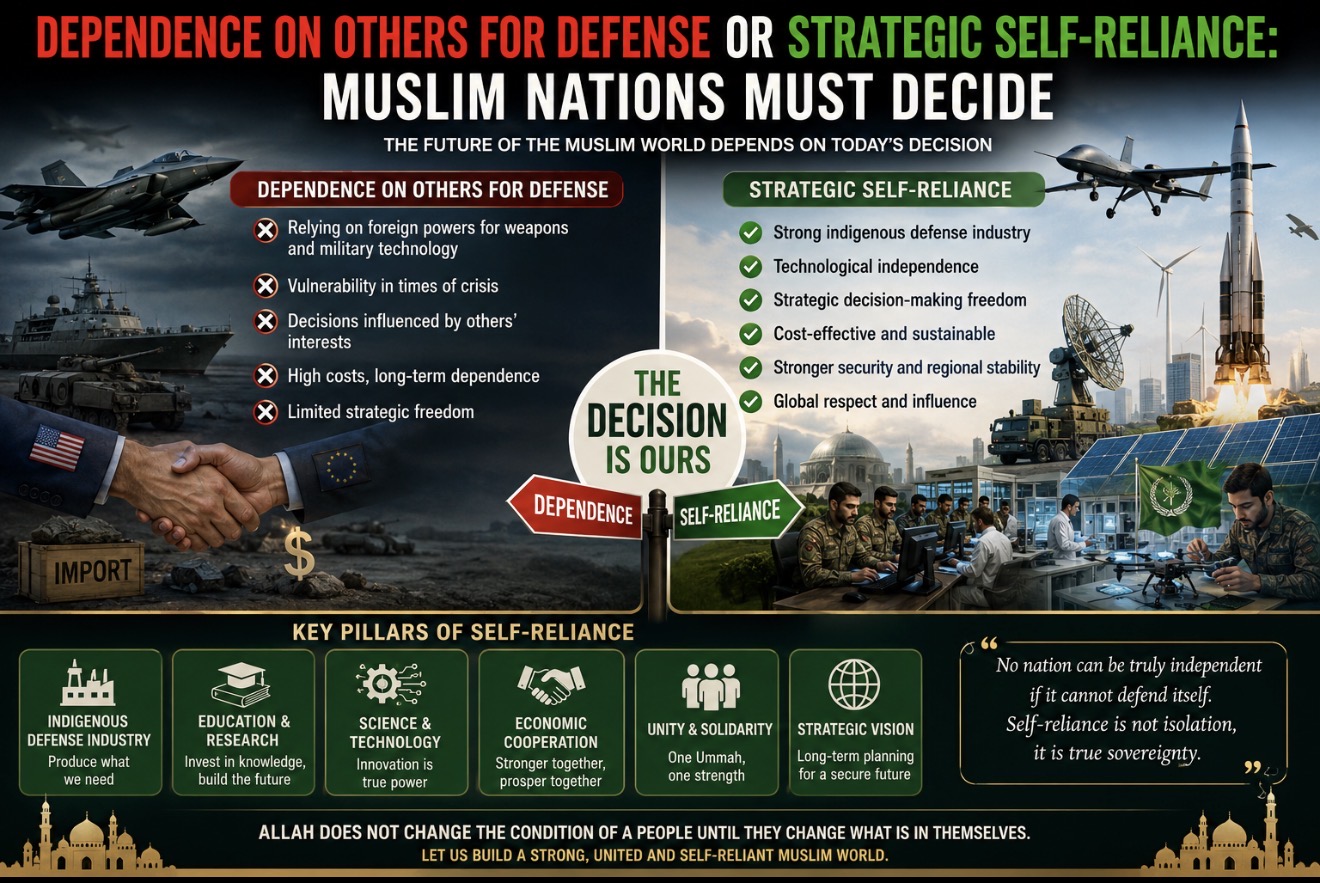
Dependence on Others for Defense or Strategic Self-Reliance: Muslim Nations Must Decide
Introduction
The recent conflicts in the Middle East have once again exposed a harsh reality of modern geopolitics: nations that spend billions of dollars on imported weapons are not always guaranteed protection when real crises emerge. Strategic alliances operate according to interests, not emotions, and global powers prioritize their own security objectives before anyone else’s.
For decades, many Muslim countries invested enormous wealth in purchasing advanced military equipment from foreign powers. Fighter jets, missile defense systems, naval fleets, and surveillance technologies were acquired with the expectation that strong alliances would ensure long-term protection. However, recent events have raised difficult questions regarding the reliability of external security guarantees.
The Illusion of Guaranteed Protection
Recent regional tensions demonstrated that even close allies may not always receive the expected level of support during moments of crisis. International responses often focused primarily on broader geopolitical calculations and the protection of strategic allies rather than the collective security concerns of the Muslim world.
This reality highlights an important lesson: no foreign power will ever prioritize another nation’s interests above its own.
Global politics has always been driven by national interests. Therefore, countries that rely entirely on outside powers for defense remain strategically vulnerable during uncertain times.
The Untapped Strength of the Muslim World
The Muslim world possesses immense potential and strategic advantages. Muslim-majority nations control some of the world’s most important energy reserves and occupy critical geographic routes linking Asia, Africa, and Europe. Collectively, they represent a population of more than a billion people with significant economic and human resources.
Countries such as Saudi Arabia, Turkey, Pakistan, Malaysia, Indonesia, and Qatar possess financial strength, growing industrial capacity, and strategic influence. Yet despite these advantages, many Muslim countries still depend heavily on external powers for military technology, intelligence systems, and defense infrastructure.
Why Defense Sovereignty Matters
Defense sovereignty does not mean isolation from the world or hostility toward international partnerships. Alliances remain important in modern diplomacy. However, true sovereignty requires the ability to defend national interests independently when circumstances demand it.
A nation that cannot secure its borders, protect its economy, or maintain strategic deterrence without external assistance remains exposed to political pressure and foreign influence.
Strategic independence strengthens national confidence and allows countries to make decisions based on their own priorities rather than external expectations.
Building Indigenous Defense Industries
One of the most important steps toward self-reliance is the development of local defense industries. Muslim countries must gradually move from being major importers of weapons to becoming producers of military technology.
Investment in aerospace engineering, drone technology, cyber security, missile systems, naval manufacturing, and artificial intelligence can reduce long-term dependence on foreign suppliers.
Turkey provides an important example of how investment in indigenous defense production can improve strategic autonomy and increase global influence.
Education, Science, and Technology
Modern military strength is no longer determined only by the number of weapons a country possesses. Technological superiority, scientific research, cyber capabilities, and innovation now define global power.
For this reason, Muslim nations must prioritize:
- Technical education
- Research universities
- Artificial intelligence
- Engineering and industrial development
- Scientific innovation
Without strong educational foundations, long-term strategic independence cannot be achieved.
The Need for Muslim Unity and Cooperation
The Muslim world also needs stronger economic and strategic cooperation among its nations. Joint defense initiatives, technology-sharing agreements, regional investment projects, and increased trade integration can strengthen collective stability and reduce external dependence.
Economic unity can become a major source of geopolitical influence if Muslim countries coordinate their resources and long-term policies effectively.
A Defining Choice for the Future
The changing global order presents Muslim nations with a historic choice. They can continue relying heavily on foreign powers for protection, or they can begin building the foundations of genuine defense sovereignty and strategic independence.
History repeatedly shows that nations fully dependent on others for security often face limitations in protecting their national interests and foreign policy independence.
The future of the Muslim world will depend on the decisions made today. Self-reliance, unity, education, and strategic vision are no longer optional — they are essential for survival, dignity, and long-term stability.
Syed Ali Raza Naqvi Bukhari
Unity of Peace, Economic Reform, and Global Unity
Founder & Chairman of Tehreek Istehkam Pakistan, and the author of “Law of God” and “Social Democratic System.” advocates for truth, social justice, and reform in all sectors of society.


Comments
Post a Comment