Holocaust and Gaza: When Humanity Fails — Why All Atrocities Must Be Condemned Equally.
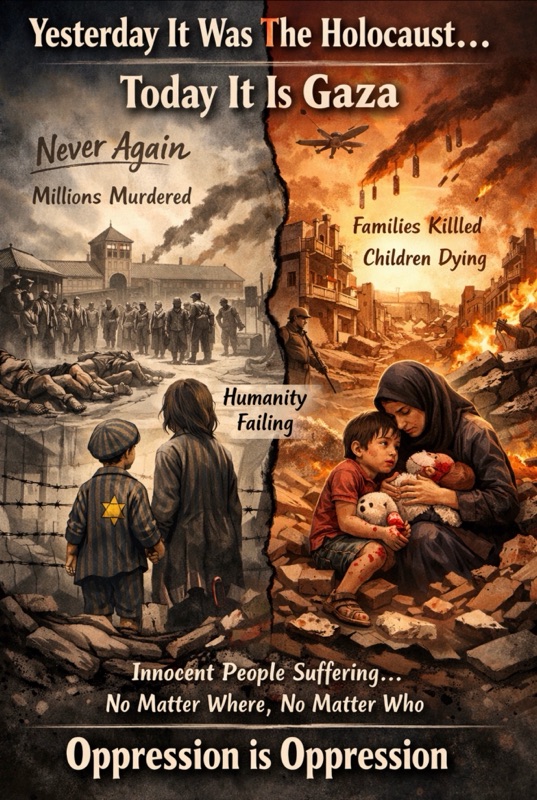
Holocaust and Gaza: When Humanity Fails — Why All Atrocities Must Be Condemned Equally
Introduction
History repeatedly confronts humanity with moments of moral failure. Whether in 20th-century Europe or in today’s Middle East, one principle remains constant: the deliberate or reckless harm of civilians is ظلم (oppression), and those responsible must be held accountable.
This article does not equate events simplistically, but rather examines them through a shared moral and legal lens: human dignity, international law, and accountability.
The Holocaust: A Documented Crime Against Humanity
The The Holocaust (1933–1945) remains one of the most horrific atrocities in modern history.
What Happened?
- Approximately 6 million Jews were systematically murdered by Nazi Germany under Adolf Hitler
- Millions of others (Roma, disabled individuals, political dissidents) were also killed
- Victims were:
- Dehumanized through propaganda
- Confined in ghettos and camps
- Executed in gas chambers and mass shootings
Responsibility
- The Nazi regime (state apparatus of Germany at the time)
- Military and administrative structures that enabled genocide
- Collaborators across occupied Europe
Global Consensus
- Universally recognized as:
- Genocide
- Crime against humanity
- Led to the creation of:
- Modern human rights law
- The Genocide Convention
👉 There is no debate: it was ظلم, and those responsible are historically condemned.
Gaza: A Contemporary Humanitarian Crisis
The situation in Gaza Strip has drawn global attention due to repeated cycles of violence and humanitarian suffering.
What Is Happening?
- Large-scale military operations have resulted in:
- Civilian casualties, including women and children
- Destruction of homes, hospitals, and infrastructure
- Long-term blockade conditions have:
- Restricted movement
- Limited access to food, water, and medical care
Legal and Humanitarian Concerns
International organizations, including the United Nations, have raised concerns about:
- Disproportionate use of force
- Collective punishment
- Possible violations of international humanitarian law
Some legal experts and institutions have also debated whether certain actions could amount to:
- War crimes
- Crimes against humanity
(These require formal legal determination by courts such as the International Criminal Court)
Responsibility and Accountability
In the Holocaust
- Responsibility was clear, centralized, and ideologically driven
- Accountability came after the war (e.g., Nuremberg Trials)
In Gaza
- Responsibility is more complex and contested
- However, key principles remain:
- States are responsible for their military actions
- Armed groups are also bound by international law
- Civilian protection is mandatory—not optional
👉 Accountability must apply to all actors, without exception
Are These Situations the Same?
No—they are not identical in scale, structure, or historical context.
But they share one critical moral principle:
When civilians are dehumanized, displaced, or killed in large numbers, humanity is failing again.
The Danger of Double Standards
One of the biggest ethical failures in global politics is inconsistency:
- Condemning past atrocities
- But hesitating to condemn present suffering
This creates:
- Loss of moral credibility
- Continued cycles of injustice
👉 Justice cannot be selective
A Universal Principle
Whether:
- Nazi Germany in Europe
- Or any modern conflict zone
The rule must remain:
✔ Civilian lives are sacred
✔ Power does not justify violence
✔ Law must apply equally
Conclusion
The Holocaust stands as a permanent warning of where unchecked power and hatred can lead.
The suffering in Gaza reminds us that:
history is not just something we study—it is something we risk repeating.
If we truly learned from the past, then our response today must be clear:
👉 Oppression is oppression.
👉 Civilian suffering is unacceptable.
👉 And those responsible—whoever they are—must be held accountable.
Syed Ali Raza Naqvi Bukhari
Unity of Peace, Economic Reform, and Global Unity
Founder & Chairman of Tehreek Istehkam Pakistan, and the author of “Law of God” and “Social Democratic System.” advocates for truth, social justice, and reform in all sectors of society.


Comments
Post a Comment