Global Economic Shockwaves: Lessons from 1970, 2008, and the 2026 Iran–Israel–U.S. Conflict.
Picture just for Reference
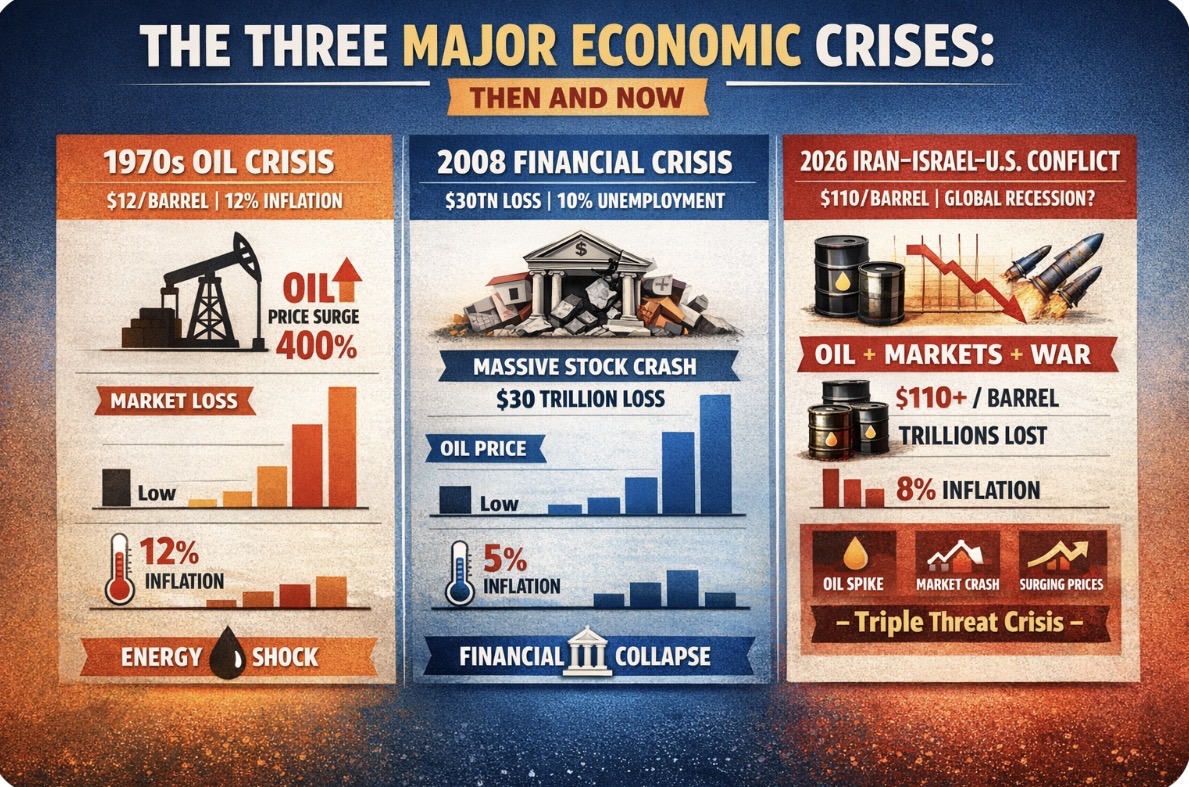
Global Economic Shockwaves: Lessons from 1970, 2008, and the 2026 Iran–Israel–U.S. Conflict.
The ongoing geopolitical tensions between Iran, Israel, and the United States have triggered a significant global economic disturbance. Financial markets, energy prices, and investor confidence have all been shaken, raising fears of a broader economic downturn. To understand the scale of this crisis, it is essential to compare it with two major historical events: the 1970s Oil Crisis and the 2008 Global Financial Crisis.
1. Immediate Impact of the 2026 Conflict
📉 Stock Markets Collapse
- U.S. markets saw the Dow Jones Industrial Average fall by approximately 600 points in early trading.
- Asian and European markets declined by 1–2%.
- Pakistan’s KSE-100 Index plunged nearly 9.5% (~16,000 points) in a single shock.
- India lost roughly $130 billion (₹11 lakh crore) in market capitalization.
👉 Estimated global loss: Trillions of dollars wiped out within days.
⛽ Oil Price Surge
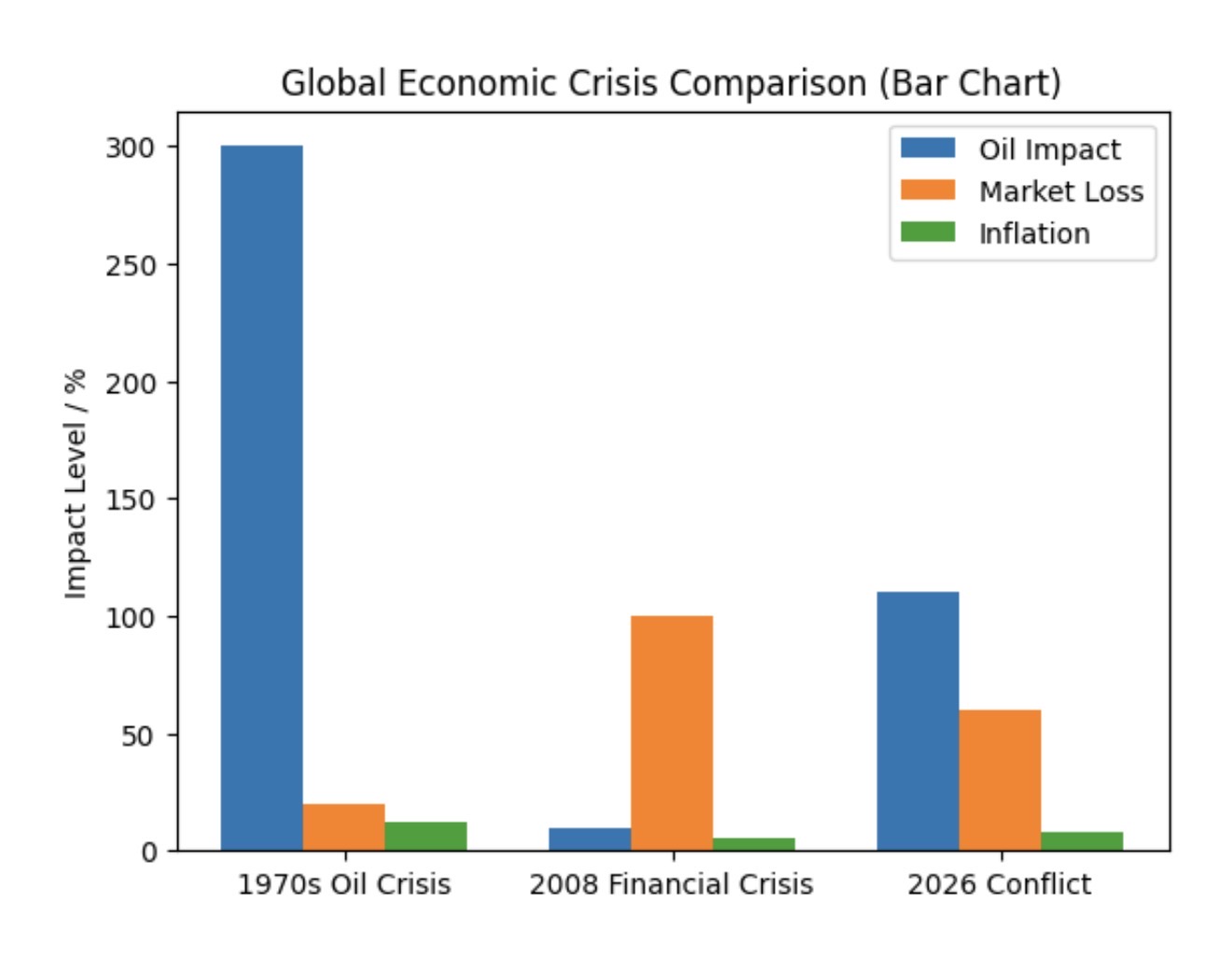
- Crude oil prices surged beyond $110 per barrel.
- Daily spikes of up to 11% were recorded due to fears over the Strait of Hormuz.
👉 Around 20% of the world’s oil supply passes through this route, making it the most critical energy chokepoint globally.
🌍 Macroeconomic Effects
- Rising inflation (“war-driven inflation”)
- Slowing global growth
- Increasing risk of a global recession
2. Comparison with the 1970s Oil Crisis
📌 Background
The 1973 Oil Crisis began when OPEC countries imposed an oil embargo.
📊 Key Statistics
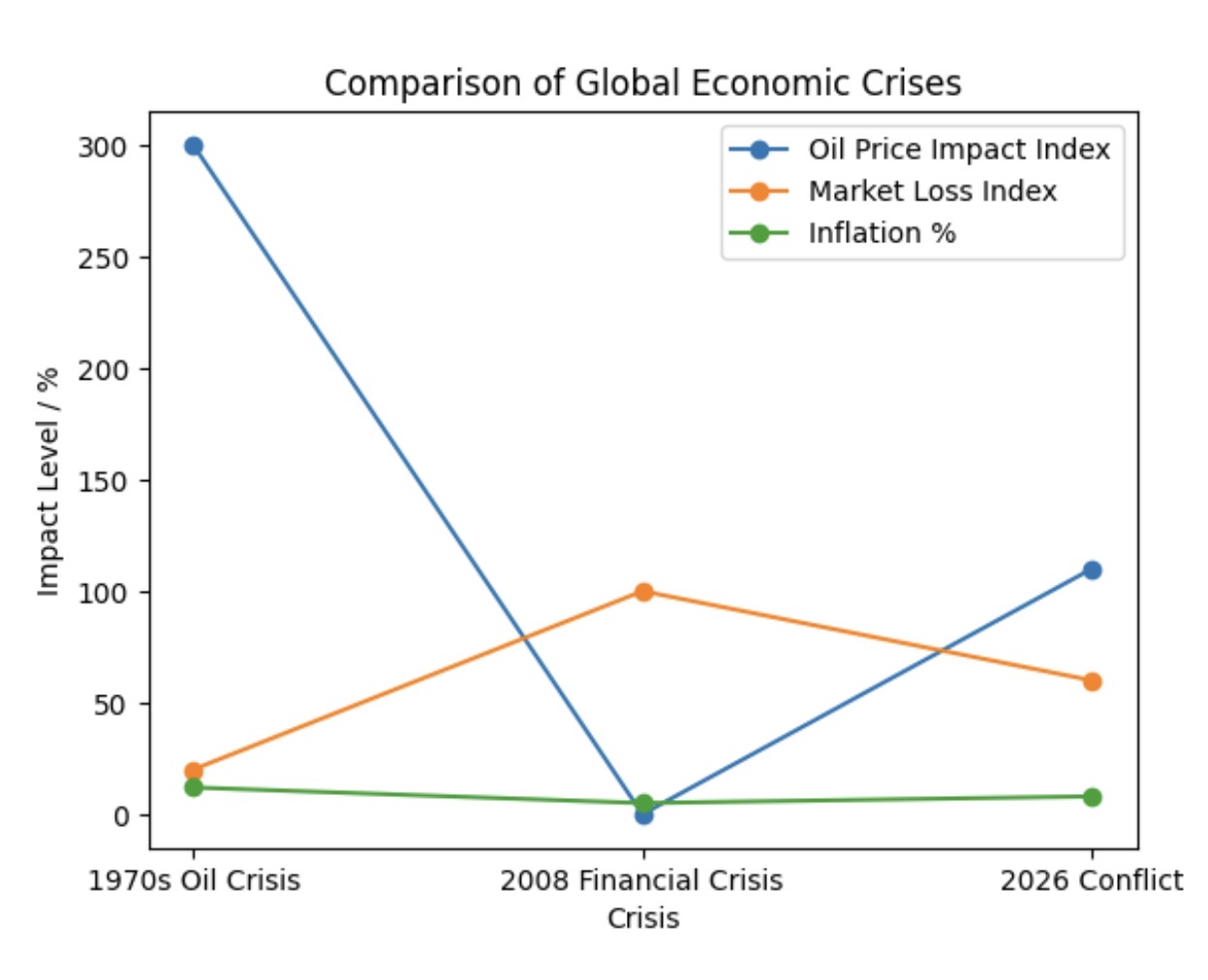
- Oil prices increased by 300–400% (from ~$3 to ~$12 per barrel).
- U.S. inflation rose to 12% by 1974.
- Global GDP growth dropped sharply.
- Unemployment surged across Western economies.
⚠️ Economic Impact
- Severe stagflation (high inflation + low growth)
- Energy shortages and rationing
- Long-term structural economic shifts
👉 Similarity to 2026:
- Oil supply disruption fears
- Energy-driven inflation
👉 Difference:
- 1970s crisis was purely energy-based, while 2026 includes financial market and geopolitical complexities.
3. Comparison with the 2008 Financial Crisis
📌 Background
The 2008 Global Financial Crisis was triggered by the collapse of the housing market and financial institutions.
📊 Key Statistics
- Global stock markets lost over $30 trillion in value.
- U.S. GDP contracted by ~4.3%.
- Unemployment in the U.S. reached 10%.
- Major institutions like Lehman Brothers collapsed.
⚠️ Economic Impact
- Banking system crisis
- Credit freeze
- Massive government bailouts
👉 Similarity to 2026:
- Market panic and volatility
- Risk of financial contagion
👉 Difference:
- 2008 was financial-system driven, while 2026 is geopolitical + energy + financial combined.
4. Sector-Wise Impact of the 2026 Crisis
🏭 Industry & Trade
- Supply chains disrupted
- Manufacturing costs rising
- Shipping routes under threat
✈️ Aviation
- Airline stocks dropped by 5–6%
- Flight routes disrupted due to conflict zones
💵 Currency Markets
- U.S. dollar strengthened as a “safe haven”
- Emerging market currencies (including Pakistan) weakene
🏦 Banking & Finance
- Interest rates rising
- Borrowing costs increasing globally
- Mortgage risks increasing in Western economies
5. The Hidden Risk: A Combined Crisis
Unlike 1970 or 2008, the current crisis combines:
- Energy Shock (like 1970s)
- Financial Instability (like 2008)
- Geopolitical Conflict (new dimension)
👉 This creates a “Triple Shock Scenario”:
- Oil supply disruption
- Market instability
- Global uncertainty
6. Global Economic Outlook
📉 Short-Term (0–6 months)
- Continued market volatility
- High oil prices
- Rising inflation
📉 Medium-Term (6–18 months)
- Slower economic growth
- Possible recession in major economies
📉 Long-Term Risk
- Structural shift in global trade and energy systems
- Increased geopolitical fragmentation
7. Conclusion
The 2026 Iran–Israel–U.S. conflict is not just a regional war—it is a global economic turning point. When compared with the 1973 Oil Crisis and the 2008 Financial Crisis, it becomes clear that the world is facing a more complex and interconnected threat.
If the conflict continues, the global economy could experience:
- Sustained inflation
- Prolonged market instability
- A potential recession
In essence, this crisis carries the inflationary shock of the 1970s and the financial instability of 2008, making it one of the most dangerous economic situations of the modern era.
Syed Ali Raza Naqvi Bukhari
Unity of Peace, Economic Reform, and Global Unity
Founder & Chairman of Tehreek Istehkam Pakistan, and the author of “Law of God” and “Social Democratic System.” advocates for truth, social justice, and reform in all sectors of society.


Comments
Post a Comment