Is Iran the New Power in the Middle East and Gulf?
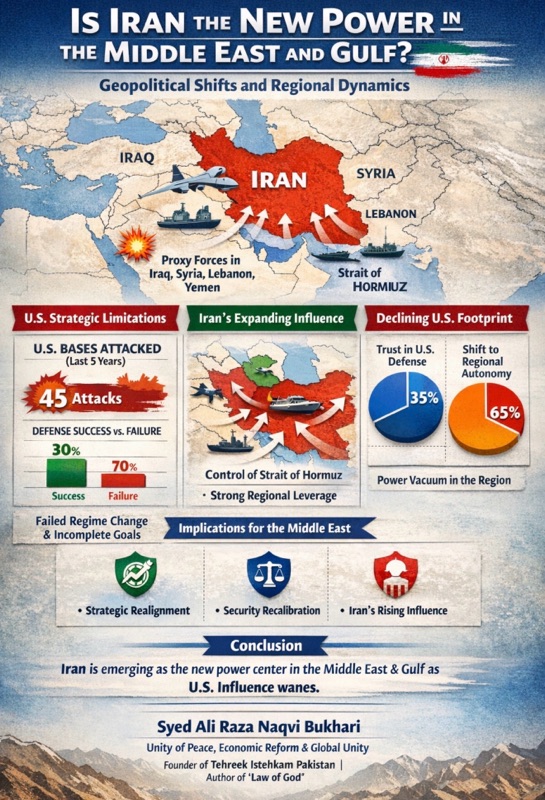
Is Iran the New Power in the Middle East and Gulf?
The geopolitical landscape of the Middle East and the Gulf is rapidly shifting, and Iran appears to be emerging as a central player. Recent events have highlighted several key developments that may redefine the regional power balance.
America’s Strategic Setbacks
Despite decades of involvement and billions of dollars invested in military presence and defense systems, the United States has struggled to achieve its core objectives in the region. Efforts aimed at regime change, containing Iran’s influence, or fully securing allies have often fallen short. Attacks on U.S. bases and allied positions have exposed vulnerabilities in defense mechanisms that were once considered invincible.
Iran’s Rising Influence
Iran has consolidated its position in the Gulf and the broader Middle East through a combination of military, political, and proxy strategies:
- Military Capability: Advanced missile systems, drones, and control over critical chokepoints like the Strait of Hormuz.
- Regional Proxies: Support for groups across Iraq, Syria, Lebanon, and Yemen ensures Iran’s influence extends beyond its borders.
- Political Leverage: Iran’s resilience against external pressure enhances its status as a formidable regional actor.
These developments have established a perception—whether symbolic or practical—that Iran now holds a dominant role in shaping the region’s strategic environment.
The Declining American Footprint
If the United States cannot achieve its primary objectives and is forced to reduce its presence, the resulting vacuum will reinforce Iran’s image as a dominant power. Even allies like Israel and the Gulf states, despite receiving military support, face growing doubts about their security and the reliability of U.S. protection. This creates an opportunity for Iran to assert itself both politically and strategically.
Implications for the Middle East
- Strategic Shift: Regional policies and alliances may increasingly reflect Iran’s growing influence.
- Security Dynamics: Gulf nations may reassess defense strategies, seeking self-reliance or new alliances.
- Perception vs. Reality: While Iran may not control every aspect of the region, the perception of its power significantly alters the regional power narrative.
Conclusion
Iran’s resilience, strategic planning, and regional influence suggest it is poised to become the Middle East and Gulf’s new power center. The United States’ inability to fully achieve its objectives only accelerates this shift, leaving Iran in a position to shape the region’s future—politically, militarily, and strategically.
Syed Ali Raza Naqvi Bukhari
Unity of Peace, Economic Reform, and Global Unity
Founder & Chairman of Tehreek Istehkam Pakistan, and the author of “Law of God” and “Social Democratic System.” Advocate for truth, social justice, and reform in all sectors of society.


Comments
Post a Comment