Ukraine: A Deer Between Two Lions — Lessons for Weak States in the Age of Resource Wars.
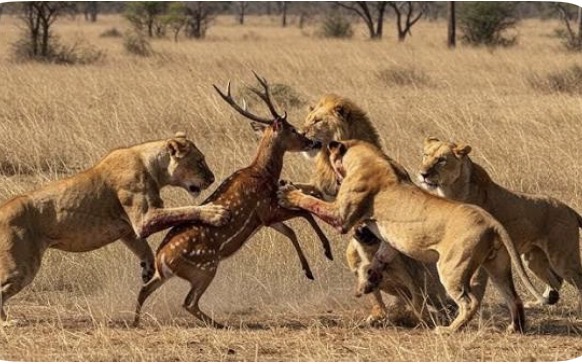
Ukraine: A Deer Between Two Lions — Lessons for Weak States in the Age of Resource Wars.
The modern international system claims to be governed by rules, institutions, and moral principles. Yet recent global events reveal a harsher truth: the world is drifting back toward an old era, where power overrides law, resources outweigh ethics, and weak states become expendable.
Ukraine stands as the clearest symbol of this reality—a deer trapped between two lions.
The Metaphor Explained
Ukraine is not merely a victim, nor a master strategist. It is a geographically critical but structurally vulnerable state, positioned between two immense power blocs:
- Russia, a traditional imperial power seeking security, influence, and strategic depth
- Europe (backed by the United States/NATO), aiming to contain Russia, secure resources, and protect its geopolitical frontier
Like a deer:
- Ukraine lacks the raw power to dominate its environment
- Its land becomes the battleground
- Its people pay the price
Like lions:
- The great powers fight indirectly
- They calculate costs and benefits
- They ultimately seek settlement—not destruction of each other
The tragedy is that the settlement never prioritizes the deer.
This Is Not a Simple Moral War
The Ukraine conflict is often framed as:
- Democracy vs authoritarianism
- Freedom vs aggression
But such framing hides the deeper structure of the conflict.
At its core, this war is about:
- Resources (grain, land, minerals, energy transit routes)
- Geography (buffer zones, military depth, borders)
- Power balance (preventing or enabling expansion)
Moral language is used to mobilize support, but strategic interests drive decisions.
The Return of the Old Era
Historically, wars were fought for:
- Land
- Gold
- Food
- Animals
- Trade routes
Today, wars are fought for:
- Oil and gas
- Strategic minerals (lithium, cobalt, rare earths)
- Food security (grain, water, arable land)
- Currency dominance (the dollar system)
- Supply chain control
The weapons have changed:
- From swords to sanctions
- From cavalry to drones
- From occupation to asset freezes
But the logic remains unchanged.
Powerful states secure their needs; weak states absorb the damage.
The Core Rule of Modern Geopolitics
Our era is governed by a brutal but consistent rule:
When confrontation occurs, weak states are destroyed.
When compromise becomes necessary, strong states settle with each other.
Ukraine illustrates this rule clearly:
- Cities are destroyed
- The economy collapses
- Generations are displaced
Yet final decisions will be made in:
- Moscow
- Washington
- Brussels
Not in Kyiv.
Why Weak States Always Suffer Most
Weak states fail not because they are immoral or undeserving, but because they lack:
- Strategic autonomy
- Economic self-reliance
- Internal unity
- Long-term geopolitical vision
In a power-driven system:
- International law is selectively enforced
- Morality becomes a narrative tool
- Institutions reflect the interests of those who dominate them
Weak states are punished for miscalculation; strong states are forgiven for aggression.
From Ukraine to the Wider World
Ukraine is not an exception—it is a precedent.
The same dynamics are visible in:
- Venezuela (oil politics)
- Africa (minerals and energy competition)
- Greenland and the Arctic (rare earths and new sea routes)
- Food-producing regions under climate stress
This is neo-colonialism without formal colonies.
The Illusion of Protection
One of the most dangerous beliefs among weak states is the idea that:
- Moral alignment guarantees security
- Powerful allies will protect indefinitely
- International sympathy ensures survival
History repeatedly proves otherwise.
Support lasts as long as interests align.
When costs rise, priorities change.
Lessons Weak States Must Learn
If weak and developing states wish to survive this returning old era, they must internalize hard truths:
1. Balance Is Survival
Choosing sides emotionally turns states into battlegrounds.
2. Self-Reliance Is Defense
Food, energy, and financial independence matter more than slogans.
3. Institutions Matter More Than Leaders
Personalized power collapses quickly under pressure.
4. Avoid Becoming a Frontline State
Strategic importance without strength invites destruction.
5. Quiet Diplomacy Beats Loud Alignment
Those who shout loyalty often pay the highest price.
Conclusion: The Tragedy of the Deer
Ukraine’s tragedy is not that it chose wrongly.
Its tragedy is that it existed in the wrong place without sufficient power.
In the age we are entering:
- Power defines law
- Resources define alliances
- Weakness invites intervention
The world is not moving forward into a more ethical order.
It is circling back to a scarcity-driven, power-centered system.
Those who recognize this early may survive.
Those who ignore it will become the next deer between lions.
Author
Syed Ali Raza Naqvi Bukhari
Unity of Peace, Economic Reform, and Global Unity
Founder & Chairman of Tehreek Istehkam Pakistan, and author of “Law of God” and “Social Democratic System.”
Advocate for truth, social justice, and reform in all sectors of society.


Comments
Post a Comment