TWH — THE WORLD & HUMANITY TODAY SPECIAL EDITION
TWH — THE WORLD & HUMANITY
TODAY SPECIAL EDITION
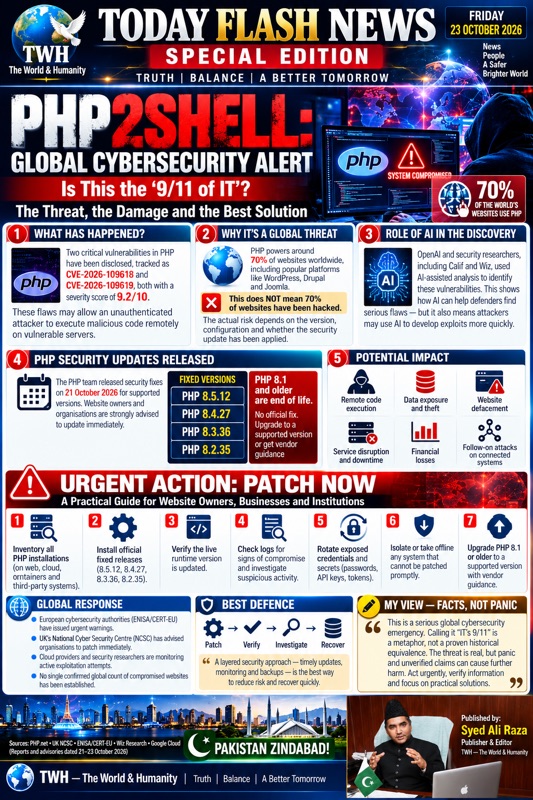
PHP2Shell: Is This the “9/11 of IT”?
AI-Discovered Vulnerabilities Put the Global Web on High Alert — The Threat, the Damage and the Road to Recovery
Date: Friday, 23 October 2026
Special Report | Global Cybersecurity | Artificial Intelligence | Digital Infrastructure
By Syed Ali Raza
Publisher & Editor — TWH, The World & Humanity
Executive Summary
The global digital community is confronting a serious cybersecurity incident after researchers identified two critical vulnerabilities in PHP, a programming language used by a vast proportion of websites and web applications.
The vulnerabilities, tracked as CVE-2026-109618 and CVE-2026-109619, were publicly disclosed on 21 October 2026. Emergency security releases followed, and cybersecurity authorities urged organisations to identify affected systems and apply the available fixes immediately.
The vulnerabilities are especially concerning because, under certain conditions, they may allow an unauthenticated attacker to execute malicious code remotely on a vulnerable server. Successful exploitation could expose confidential information, compromise websites, disrupt services and potentially provide a foothold for attacks against connected systems. <Cite refs={[“turn873584search0”,“turn873584search3”,“turn873584search4”]}/>
The incident has also highlighted the growing role of artificial intelligence in cybersecurity. AI-assisted research helped identify weaknesses in widely used software that had existed for years. The same technological capabilities could also accelerate malicious activity if used by attackers.
The central message is clear: this is a genuine global cybersecurity emergency requiring rapid, coordinated action. However, there is no basis for claiming that 70% of the world’s websites have already been hacked.
1. What Exactly Has Happened?
PHP, short for PHP: Hypertext Preprocessor, is a server-side programming language used to build dynamic websites, process forms, manage sessions, communicate with databases and support web applications.
It is widely used by content-management systems and services, including WordPress, Drupal and Joomla. Its presence throughout the web means a vulnerability in the PHP runtime can have consequences extending well beyond one website or one software company.
On 21 October, PHP published security updates addressing two critical vulnerabilities. Researchers and cybersecurity authorities warned that the weaknesses could permit remote code execution without requiring an attacker to authenticate first. <Cite refs={[“turn873584search1”,“turn873584search2”,“turn873584search6”]}/>
The issue has become known in security reporting as PHP2Shell.
This name should not be confused with an individual malware family or proof that a single coordinated attack has compromised the internet. It refers to a serious vulnerability situation that may give attackers a route to execute commands on affected systems.
The two vulnerabilities
CVE-2026-109618 — Memory corruption
PHP’s handling of certain out-of-memory conditions can leave internal request data in an unsafe state. Under specific circumstances, an attacker may be able to exploit the resulting memory corruption to execute code.
CVE-2026-109619 — Stale internal state
In certain error-handling situations, internal state can continue to refer to memory that has already been released. A later request may encounter this unsafe state before it is properly reset, potentially enabling code execution.
Both vulnerabilities received a severity score of 9.2 out of 10 from the PHP security team. The score indicates a critical risk, although the actual exposure of a particular system depends on its environment and configuration. <Cite refs={[“turn873584search0”,“turn873584search1”,“turn873584search4”]}/>
These are not simply website-design bugs. They affect the underlying software that processes requests on a server, which makes identifying and fixing the vulnerable runtime particularly important.
2. Why Is the “70% of Websites” Figure Important?
Wiz Research and reporting by the Associated Press describe PHP as powering approximately 70% of websites worldwide. This figure illustrates the technology’s enormous reach and explains why a flaw in its core runtime has attracted international attention. <Cite refs={[“turn873584search6”,“turn873584news8”]}/>
However, the figure must be interpreted carefully.
It does not mean that 70% of websites have been breached. It does not establish that every PHP installation is equally exposed, that every vulnerable installation has been attacked, or that every attack attempt has succeeded.
The actual risk depends on several factors:
- Which PHP version is running.
- Whether the relevant security update has been installed.
- How the PHP runtime is deployed and configured.
- Whether the service is accessible from the internet.
- Whether the hosting provider has applied a supported security fix.
- Whether an attacker has already gained access before remediation.
The scale of PHP usage creates a large potential attack surface. It does not, by itself, establish the number of compromised websites.
This distinction matters for businesses, governments, journalists and the public. Accurate reporting encourages urgent action without creating unnecessary panic.
3. What Damage Could a Successful Attack Cause?
The possible consequences are serious because a compromised web server may hold sensitive information or connect to other important systems.
A. Theft of confidential information
Depending on the server’s permissions and architecture, an attacker may be able to access information available to the compromised process. This could include customer records, contact details, application secrets or other sensitive data.
Exposure of passwords or authentication tokens may create additional risks if those credentials are reused elsewhere.
B. Website defacement and manipulation
An attacker with sufficient access could modify website content, publish fraudulent messages, redirect visitors or interfere with legitimate services.
For news organisations, financial services, government portals and e-commerce businesses, such manipulation can damage public trust even if the incident is contained quickly.
C. Financial losses
Businesses may face incident-response expenses, forensic investigations, service interruptions, recovery costs, customer notifications and potential regulatory consequences.
Online retailers could lose sales during downtime. Smaller companies may struggle to recover if their websites, backups and business systems are compromised simultaneously.
D. Ransomware and follow-on attacks
A vulnerable web server could become an entry point for additional malicious activity. Depending on the attacker’s access and the network design, this may include attempts to steal credentials, move into connected systems, deploy malware or disrupt operations.
However, PHP2Shell does not automatically mean ransomware will be installed. These are possible downstream consequences, not inevitable outcomes.
E. Government and critical-service disruption
Government portals, educational platforms, healthcare services and other organisations may use PHP directly or depend on products that include PHP components.
A compromised system could interrupt public services or expose information. The seriousness of the consequences depends on the system’s purpose, the data it holds and the extent of the compromise.
F. Damage to public confidence
Even when direct financial losses are limited, repeated security incidents can undermine confidence in online banking, e-commerce, government services and digital communication.
The wider lesson is that cybersecurity is not merely a technical concern. It is also an issue of public trust, economic resilience and institutional responsibility.
4. Is This the IT Equivalent of 9/11?
The comparison is understandable as a way of expressing the potential scale of concern. The vulnerabilities affect foundational software, the possible attack surface is enormous, and AI-assisted research has brought renewed attention to weaknesses in established technology.
But the analogy should be treated as a metaphor, not a confirmed historical judgment.
The September 11 attacks were a specific terrorist event involving mass casualties and profound geopolitical consequences. PHP2Shell is a cybersecurity vulnerability incident with potentially serious technical, economic and social consequences.
As of 23 October 2026, the verified information supports describing PHP2Shell as a major global cybersecurity emergency. It does not establish that its eventual impact will be comparable to 9/11 in human, economic or historical terms.
The most useful questions are therefore practical:
- How many systems are actually vulnerable?
- How many have been successfully compromised?
- How quickly can organisations install and verify fixes?
- Can attackers exploit unpatched systems before remediation?
- How effectively can governments, researchers and technology providers coordinate their response?
Answers to these questions will provide a more reliable measure of the incident’s eventual impact than dramatic comparisons.
5. The AI Factor: A New Era in Cybersecurity
Artificial intelligence has become an important part of the response to this incident.
According to OpenAI’s disclosure, Calif identified a critical PHP flaw using GPT-5.6 Sol as part of the Patch the Planet initiative. Wiz Research also independently discovered and reported the vulnerabilities, using a combination of its own research tools and AI models. The PHP maintainers then led the work to prepare and release fixes. <Cite refs={[“turn873584search6”,“turn873584search7”]}/>
This illustrates an important change in the cybersecurity landscape.
How AI can help defenders
AI-assisted security research can help specialists:
- Identify unusual patterns in source code.
- Examine complicated error-handling behaviour.
- Develop test cases for potential weaknesses.
- Validate proposed fixes.
- Review large codebases more efficiently.
- Analyse logs and prioritise suspicious activity.
These capabilities may help researchers find flaws that have escaped detection for years.
How AI can increase risks
The same general capabilities can also lower barriers to malicious activity. Attackers may use AI to understand public vulnerability reports, automate parts of their research, adapt known techniques or increase the speed of reconnaissance.
AI does not eliminate the need for expertise, and it does not guarantee that a vulnerability can be exploited successfully. Human judgment, access controls, software testing and responsible disclosure remain essential.
The critical lesson
AI can help uncover a vulnerability, but the discovery is only the beginning. The software must still be patched, the patch must be deployed, and affected systems must be checked for evidence of compromise.
Finding a flaw is not the same as securing the internet. Implementation is what converts research into protection.
6. What Is the Situation as of 23 October 2026?
The PHP security releases were made available on 21 October. European cybersecurity authorities, the United Kingdom’s National Cyber Security Centre and other organisations have urged operators to identify affected systems and apply the appropriate fixes. <Cite refs={[“turn873584search2”,“turn873584search3”,“turn873584search4”]}/>
The important developments are:
- Two critical PHP vulnerabilities have been publicly disclosed.
- Security updates are available for supported release branches.
- Researchers have demonstrated serious exploitation potential.
- Cybersecurity authorities have called for immediate remediation.
- Organisations must identify PHP installations, including those embedded in third-party products.
- Older, unsupported PHP versions require particular attention because normal security updates may no longer be available.
The existence of a patch does not mean the incident is over. Large organisations may operate thousands of applications, virtual machines, containers and third-party systems. Some installations are poorly documented, and some applications require testing before updates can be deployed safely.
For that reason, the response will involve more than releasing an update. It requires asset discovery, prioritisation, testing, deployment, verification and monitoring.
Important limitation: Public reports of exploitation attempts or proof-of-concept demonstrations do not establish that every exposed system has been compromised. Organisations must assess their own systems and available evidence.
7. Which Systems Are Affected?
The vulnerabilities have been reported across a broad range of PHP versions and deployment environments. Relevant environments may include PHP-FPM, Apache with mod_php, php-cgi, FrankenPHP and LiteSpeed. <Cite refs={[“turn873584search0”,“turn873584search5”]}/>
The PHP team released the following fixed versions:
|
PHP release branch |
Fixed release |
|
PHP 8.5 |
8.5.12 |
|
PHP 8.4 |
8.4.27 |
|
PHP 8.3 |
8.3.36 |
|
PHP 8.2 |
8.2.35 |
These are the specific patched releases identified in the advisories published on 21 October 2026. Administrators should confirm the latest available security release for their branch and operating system before deploying changes. <Cite refs={[“turn873584search0”,“turn873584search1”]}/>
PHP 8.1 and older versions have reached end of life and no longer receive normal security updates from the PHP project. Organisations using them should consult their operating-system or hosting vendor about any supported backported fix and plan a migration to a supported PHP branch.
A website owner should not assume that a product is safe merely because it is called WordPress, Drupal or Joomla. The underlying PHP runtime and any bundled components must also be checked.
8. The Best Solution: An Immediate, Layered Response
There is no single security setting that can guarantee protection. The strongest response combines emergency patching, temporary risk reduction, incident investigation and longer-term improvements.
Phase One: First 24 hours — Identify and contain the risk
Step 1: Build an inventory of PHP systems.
IT teams should identify internet-facing websites, APIs, web applications, cloud workloads, containers, internal applications and appliances that run or embed PHP.
Do not rely solely on the main website’s version display. PHP may run in separate workers, hosting accounts, containers or third-party products.
Step 2: Check the actual runtime version.
Administrators should verify the PHP version used by each production service and compare it with the official security advisory. A server may have multiple PHP versions installed, so checking only one command or one application may miss vulnerable components.
Step 3: Prioritise public-facing services.
Public websites and APIs that run vulnerable PHP should receive immediate attention. Critical business applications, services holding sensitive data and systems with privileged network access should also receive high priority.
Step 4: Patch to the appropriate fixed release.
Install the supported security release through the organisation’s normal, trusted package or hosting process. Test the update where practical, deploy it promptly and verify that the live service is actually running the fixed version.
Restart or reload the relevant services and workers as required by the deployment method. An updated package that is not running in production does not provide effective protection.
Step 5: Isolate systems that cannot be fixed promptly.
If a vulnerable service cannot be updated or adequately mitigated in time, restrict its public exposure or temporarily take it offline until the risk can be addressed. This may affect availability, but leaving a high-risk service exposed can be worse.
These priorities align with guidance from CERT-EU, ENISA and the UK’s NCSC. <Cite refs={[“turn873584search0”,“turn873584search2”,“turn873584search3”]}/>
Phase Two: First 24–72 hours — Check for compromise
Patching prevents known vulnerabilities from being exploited through the fixed code, but it does not automatically remove an attacker’s access if the server was compromised beforehand.
Security teams should:
- Review web-server, PHP, authentication and operating-system logs.
- Look for unexpected processes, files, scheduled tasks and changes to application code.
- Check for unfamiliar administrator accounts, altered permissions and suspicious outbound connections.
- Investigate unexpected access to databases, cloud credentials and other secrets.
- Preserve relevant logs and forensic evidence.
- Rotate potentially exposed credentials and tokens from a clean environment.
- Restore systems from trusted backups if compromise is confirmed and clean recovery is appropriate.
Where a breach is suspected, organisations should involve qualified incident-response specialists. Evidence should be preserved before destructive cleanup where feasible, and legal, regulatory or contractual notification obligations should be assessed.
Do not assume that installing the patch proves the server is clean.
Phase Three: First week — Secure the wider environment
Once the immediate vulnerability has been addressed, organisations should examine the systems surrounding the affected server.
Useful measures include:
- Enforcing multi-factor authentication for administrator and remote-access accounts.
- Restricting server permissions to the minimum necessary.
- Separating web servers from sensitive databases and internal systems.
- Rotating secrets that may have been exposed.
- Updating operating systems, frameworks, plugins and dependencies.
- Reviewing backup integrity and testing restoration procedures.
- Enabling centralised security logging and alerts.
- Confirming that temporary emergency changes have not created new weaknesses.
A web application firewall may provide an additional layer of protection against known attack patterns, but it must not be treated as a replacement for the security update.
Phase Four: Long-term resilience
Organisations should maintain a complete software inventory, assign clear patching responsibilities, establish emergency update procedures and conduct regular recovery exercises.
Security testing should be part of software development rather than an activity performed only after an incident. Supported software, least-privilege access, reliable backups and rehearsed incident-response plans can substantially improve an organisation’s ability to withstand future vulnerabilities.
9. What Should Different Groups Do?
Website owners and small businesses
Contact your hosting provider or technical administrator and ask four questions:
- Does my website or any underlying service use PHP?
- Is it running a vulnerable version?
- Has the appropriate security update been applied and verified?
- Has the provider checked for evidence of compromise?
If you use managed hosting, ask for written confirmation of the provider’s remediation status. Do not assume that the provider has completed the work simply because the website is online.
WordPress, Drupal and Joomla administrators
Check the PHP runtime as well as the CMS, plugins, themes and extensions. Update supported components, remove abandoned software and confirm that the production environment is using a fixed PHP release.
Do not download emergency patches from unverified websites or install unfamiliar scripts offered through social media.
Hosting companies and cloud providers
Hosting providers should identify vulnerable environments across their infrastructure, notify customers, deploy fixes where they manage the runtime and provide clear instructions where customer action is required.
Providers should also monitor suspicious activity, preserve relevant logs and communicate confirmed incidents without exaggerating or understating the risk.
Banks, hospitals and government departments
These organisations should prioritise exposed services according to operational importance, data sensitivity and the potential consequences of disruption.
They should coordinate IT, security, legal and communications teams, test recovery procedures and follow applicable incident-reporting obligations. Where critical services cannot be patched immediately, access restrictions and other compensating controls should be applied while a safe remediation plan is implemented.
Ordinary internet users
Most users cannot directly patch the PHP runtime on a website they visit, but they can reduce the consequences of an incident:
- Use unique passwords and a password manager.
- Enable multi-factor authentication where available.
- Keep personal devices and browsers updated.
- Be alert to unexpected password-reset messages and unusual login notifications.
- Avoid entering credentials after following suspicious links.
- Contact a service through its official website or application if an account alert seems unusual.
There is no need to panic or stop using the internet. The priority is for system operators to secure the services they manage while users remain alert to possible signs of account compromise.
10. What Should Pakistan Do?
Pakistan’s public institutions, businesses, universities, banks, media organisations and technology companies should treat the incident as an opportunity to strengthen digital resilience.
A national response plan
First: Establish visibility. Public and private organisations should identify critical PHP-based systems, including those operated by contractors and third-party service providers.
Second: Prioritise critical services. Internet-facing systems supporting payments, healthcare, government services, education, transport and communications should be assessed urgently.
Third: Coordinate trusted advisories. National cybersecurity authorities, sector regulators, hosting companies and technical communities should share verified mitigation guidance and incident indicators through appropriate channels.
Fourth: Support smaller organisations. Small businesses and local institutions may lack dedicated security teams. Clear instructions, trusted technical assistance and affordable managed security services can help them patch systems correctly.
Fifth: Develop local expertise. Universities and training programmes should invest in secure coding, vulnerability analysis, incident response, digital forensics and AI-assisted defensive security.
Sixth: Improve reporting and recovery. Organisations need clear channels for reporting suspected incidents, preserving evidence and restoring services safely.
Pakistan should also review its own exposure before making claims about the number of affected national websites. A global PHP usage estimate cannot establish how many Pakistani websites are vulnerable or compromised.
The objective should be practical: reduce exposure, protect public data, minimise downtime and improve the country’s capacity to respond to future cyber incidents.
11. What This Incident Means for the Global Economy
Cybersecurity incidents can create costs far beyond the immediate repair of a website.
E-commerce businesses may lose sales when services become unavailable. Banks and payment providers may need to investigate suspicious activity. Public agencies may have to divert resources to emergency response. Customers may face account resets, service delays and uncertainty about their personal information.
The impact varies widely. A vulnerable low-traffic website and a compromised service connected to sensitive business systems do not carry the same risk.
For that reason, organisations should not estimate financial damage solely from the number of websites using PHP. A credible assessment requires evidence about actual exploitation, affected data, service disruption, recovery costs and downstream consequences.
The longer-term economic lesson is that digital infrastructure needs continuous investment. Software maintenance, security testing, backup systems and skilled personnel are essential operating costs, not optional extras.
12. Accountability and the Future of Software Security
The PHP2Shell incident also raises questions about how critical open-source software is maintained and funded.
Open-source technology supports a substantial part of the modern internet, yet many widely used components depend on maintainers and contributors working with limited resources. Security fixes require careful investigation, testing, coordination and communication.
The appropriate response is not to abandon open-source software. It is to support sustainable maintenance, responsible vulnerability disclosure, independent security research and timely distribution of updates.
Organisations that benefit commercially from critical open-source projects should consider how they can contribute funding, engineering expertise, testing and long-term support.
The incident also reinforces the importance of coordination between AI developers, security researchers, software maintainers, cloud providers and governments. Discovery must be paired with responsible disclosure and remediation so that defenders can prepare before technical details become broadly available.
13. My View — A Balanced Perspective
PHP2Shell should be treated as a serious warning about the fragility and interconnectedness of modern digital infrastructure.
The internet is not a single machine that can be switched off or secured with one emergency patch. It is an ecosystem of millions of servers, applications, services and organisations, many of which depend on common software.
That interconnectedness creates enormous economic and social benefits, but it also means that one weakness can affect many independent systems.
Artificial intelligence has added a new dimension. It can help researchers examine software at a scale and speed that would be difficult to achieve manually. But the same general advances may also allow attackers to investigate weaknesses more quickly.
The best response is neither panic nor complacency. It is disciplined action: identify the risk, apply the fix, check for compromise, protect exposed information and learn from the incident.
The phrase “IT’s 9/11” may communicate the scale of public concern, but it should not substitute for evidence. The true historical significance of this event will depend on what actually happens, how much damage occurs and how effectively the global community responds.
For governments, businesses and technology providers, the responsibility is clear: cybersecurity must become a permanent priority rather than an emergency reaction.
14. Final Action Checklist
Organisations responsible for PHP-based systems should confirm the following:
- ☐ All PHP installations and embedded PHP components have been inventoried.
- ☐ Internet-facing services have been prioritised.
- ☐ The running PHP versions have been checked against the official advisory.
- ☐ Appropriate fixed releases or vendor-supported security fixes have been installed.
- ☐ Services and workers have been restarted or reloaded where required.
- ☐ The live environment has been checked to verify remediation.
- ☐ Logs and systems have been assessed for signs of previous compromise.
- ☐ Potentially exposed credentials and secrets have been rotated.
- ☐ Backups have been verified and recovery procedures tested.
- ☐ Monitoring and incident-response arrangements remain active.
- ☐ Unsupported PHP versions have a documented migration or vendor-supported remediation plan.
If any item remains incomplete, assign an owner and deadline according to the system’s exposure and criticality.
Conclusion: The Window to Protect the Internet Is Open
The PHP2Shell incident demonstrates how a weakness in widely used software can become a global security concern. The potential consequences include unauthorised code execution, data exposure, website disruption, financial loss and further attacks against connected systems.
But risk is not destiny. Security updates have been released, official guidance is available, and organisations can reduce their exposure through rapid remediation and careful investigation.
The most important measure of success will not be the number of alarming headlines published. It will be the number of vulnerable systems secured, the number of attacks prevented, the services restored safely and the lessons incorporated into future software development.
The best defence is timely action, verified information, shared responsibility and sustained investment in digital security.
The world does not need panic. It needs preparedness.
Syed Ali Raza
Publisher & Editor
TWH — The World & Humanity
Truth | Balance | A Better Tomorrow
News for a Better, More Peaceful World
Editorial disclaimer: This report is based on public security advisories and research available as of 23 October 2026. The existence of a vulnerability does not prove that a particular system has been compromised. Organisations should consult the official PHP advisory and their software or hosting vendors for environment-specific instructions.
Sources and verification
- ENISA / CERT-EU: Critical PHP vulnerabilities, technical explanation, affected versions and immediate mitigation recommendations.
- UK National Cyber Security Centre: Who is affected and what organisations should do.
- NHS England Digital: Vulnerability details, affected environments and remediation guidance.
- Wiz Research: PHP2Shell research, the role of AI and the responsible-disclosure timeline.
- OpenAI: Coordinated disclosure and AI-assisted vulnerability research.
- Associated Press: Reporting on the potential global reach and response to the vulnerabilities.
Publication recommendation: Use the headline “PHP2Shell: A Global Cybersecurity Emergency — Is This the ‘9/11 of IT’?” It communicates urgency while making clear that the historical comparison is a question, not an established fact.


Comments
Post a Comment