TODAY NEWS FLASH — INTERNATIONAL & PAKISTAN Friday, 9 October 2026
THE WORLD & HUMANITY (TWH)
TODAY NEWS FLASH — INTERNATIONAL & PAKISTAN
Friday, 9 October 2026
Global Affairs, Regional Security and Pakistan’s Economic Outlook
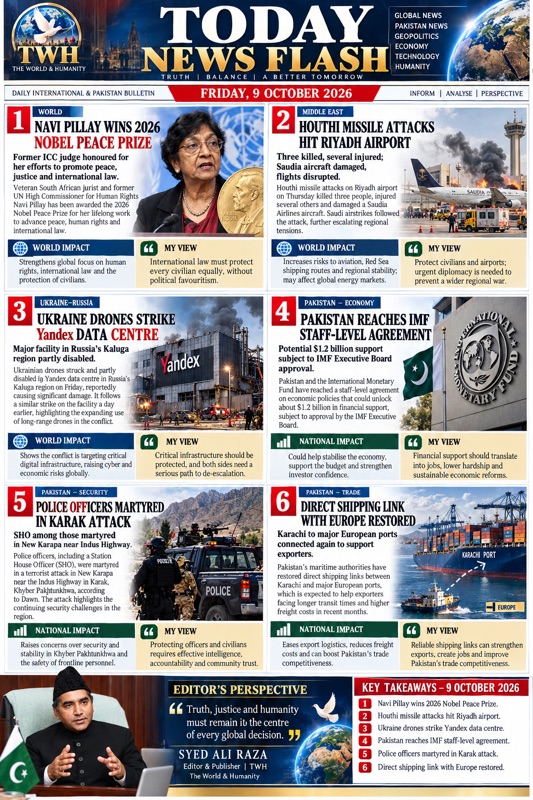
Navi Pillay Wins the 2026 Nobel Peace Prize
The international community is focusing on justice and human rights following the announcement that South African jurist Navi Pillay has won the 2026 Nobel Peace Prize for her efforts to promote peace and international law. A former United Nations High Commissioner for Human Rights, Pillay has spent much of her career working on accountability for serious international crimes. The award highlights the continuing debate over how international law can protect civilians and ensure accountability in conflicts around the world. The Nobel Committee’s announcement reinforces the importance of applying legal principles consistently, regardless of a country’s political influence.
My View: International law must protect every civilian equally. Human rights and accountability should never depend on political alliances or the identity of those responsible.
Saudi Arabia–Yemen: Attacks on Riyadh Airport Escalate Regional Tensions
Saudi Arabia reported that attacks on Riyadh’s King Khalid International Airport and an aircraft belonging to Saudia Airlines on Thursday, 8 October, killed three Saudi nationals and injured several others. Yemen’s Houthi movement claimed responsibility for targeting the airport. The attacks prompted flight disruptions and raised fresh concerns about civilian aviation and regional security. Saudi-led forces subsequently carried out strikes against Houthi positions in Yemen. The escalation is also threatening shipping routes around the Red Sea and the Bab el-Mandeb Strait, both important corridors for international trade and energy supplies.
World Impact: Continued hostilities could disrupt aviation, maritime commerce and energy markets while increasing the risk of a wider regional conflict.
My View: Civilian airports, commercial vessels and innocent people must be protected. Regional powers should pursue urgent negotiations and security arrangements that prevent further escalation rather than prolong retaliation.
Ukraine–Russia: Drone Warfare Continues to Threaten Civilian and Strategic Infrastructure
The Russia–Ukraine conflict remains a major international security concern as both sides continue to report drone attacks and damage to infrastructure. Reports from Russia’s Belgorod region said Ukrainian drone strikes killed two people on Thursday. The wider conflict continues to place civilian communities, energy systems and strategic facilities at risk. Continued attacks are deepening mistrust and making a negotiated settlement more difficult.
World Impact: Prolonged fighting threatens regional stability, increases humanitarian needs and creates uncertainty for European security and global markets.
My View: The protection of civilians must remain the priority. International efforts should focus on reducing attacks, establishing credible humanitarian safeguards and creating a realistic path towards negotiations.
Pakistan Reaches IMF Staff-Level Agreement for Up to $1.21 Billion
Pakistan and the International Monetary Fund have reached a staff-level agreement following reviews of the country’s economic programme. The agreement could unlock approximately $1.21 billion in financing, subject to approval by the IMF Executive Board. The package covers reviews under the Extended Fund Facility and the Resilience and Sustainability Facility. The IMF has acknowledged improvements in macroeconomic stability while stressing the need for stronger revenue collection, sustainable public finances, energy-sector reforms and improved governance. The agreement offers financial support, but it does not by itself resolve the challenges of inflation, employment, public debt or the cost of living.
National Impact: The financing could strengthen Pakistan’s external position and reserves, but its long-term benefits will depend on effective reforms and responsible economic management.
My View: International financial support should translate into tangible improvements in ordinary people’s lives. Pakistan needs fair taxation, lower wasteful expenditure, stronger exports, investment in skills and industry, and meaningful protection for low-income households.
Pakistan’s Security: Police Officers Martyred in Karak Attack
Security remains a serious concern in Khyber Pakhtunkhwa. According to reports published by Pakistani media, police officers, including a Station House Officer, were martyred in an attack near the Indus Highway in the Karak area. The incident highlights the continuing dangers faced by law-enforcement personnel and the wider challenge of maintaining public safety in areas affected by militancy.
National Impact: Persistent insecurity can undermine public confidence, disrupt economic activity and place additional pressure on police and other security institutions.
My View: Protecting police officers and civilians requires effective intelligence, professional training, accountability and cooperation with local communities. Security measures should be accompanied by justice, development and opportunities for young people.
Pakistan Restores Direct Shipping Links with Major European Ports
Pakistan’s maritime authorities have announced the restoration of direct shipping links between Karachi and major European ports. The move is intended to help exporters facing longer transit times and higher freight costs because of disruptions along international shipping routes. More reliable maritime connections could improve delivery schedules and strengthen the competitiveness of Pakistani products in European markets.
National Impact: Better shipping links can support exports, reduce logistical uncertainty and help businesses plan more efficiently. The ultimate benefits will depend on freight costs, service reliability and the ability of Pakistani producers to compete internationally.
My View: Trade connectivity is an important foundation for economic growth. Pakistan should combine reliable shipping services with export diversification, quality improvements, technology adoption and support for small and medium-sized businesses.
United States–Iran: Diplomatic Signals Ease Oil-Market Concerns
Global energy markets reacted to statements from US President Donald Trump indicating that Washington was not planning to attack Iran before the upcoming US midterm elections and that discussions with Tehran had been productive. Reuters reported that oil prices fell on Friday as concerns about possible supply disruptions eased. However, energy markets remain sensitive to regional conflict, sanctions and threats to shipping through the Strait of Hormuz. Any lasting improvement will depend on whether diplomatic engagement produces practical and verifiable progress.
World Impact: Reduced tensions could help stabilise energy supplies and shipping costs, while renewed confrontation could increase fuel prices and economic uncertainty worldwide.
My View: Diplomacy is preferable to a wider war. Any agreement should protect civilian lives, reduce threats to international shipping and create a credible framework for resolving outstanding disputes peacefully.
Editorial Perspective: A Call for Peace, Justice and Reform
Today’s developments show how closely international security, economic stability and human welfare are connected. Conflict in the Middle East threatens aviation, energy supplies and maritime trade. The Russia–Ukraine war continues to impose human and economic costs. Meanwhile, Pakistan faces the dual challenge of maintaining security and turning external financial support into sustainable economic progress.
The international community must avoid selective approaches to justice and human rights. Civilian protection, respect for international law, peaceful dispute resolution and accountable governance should be universal principles. For Pakistan, lasting progress requires political dialogue, public safety, economic reform, export growth and investment in education and productive employment.
My Final View — Syed Ali Raza, Editor & Publisher, The World & Humanity:
“The world needs fewer cycles of retaliation and more responsible leadership. Peace, justice, economic opportunity and human dignity must guide international relations and national policy. Our shared future depends not only on how governments exercise power, but also on how effectively they protect ordinary people and build a more stable, fair and humane world.”


Comments
Post a Comment