Which Revolution Does Pakistan Really Need?
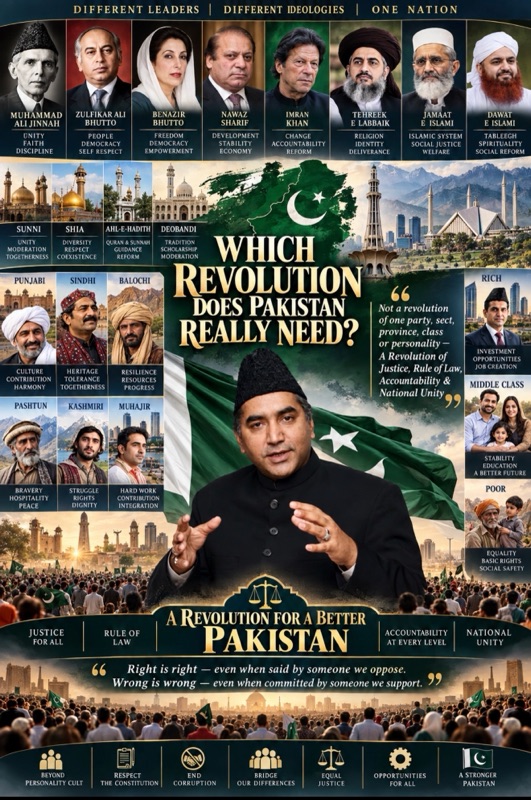
Which Revolution Does Pakistan Really Need?
For decades, Pakistan has heard the language of revolution.
At different times, we have been told about the revolution of the Pakistan Tehreek-e-Insaf, the Pakistan Peoples Party, the Pakistan Muslim League, Tehreek-e-Labbaik, religious movements, political leaders, and different social and ideological groups.
Everyone speaks of change.
Everyone claims to have a solution.
But there is a question we rarely ask:
What kind of revolution does Pakistan actually need?
A Sunni revolution?
A Shia revolution?
An Ahl-e-Hadith revolution?
A Deobandi revolution?
A religious movement’s revolution?
A revolution of the Jamaat-e-Islami?
A revolution of the Pakistan Muslim League, the Pakistan Peoples Party, Pakistan Tehreek-e-Insaf, or Tehreek-e-Labbaik?
A revolution of the rich?
A revolution of the poor?
A Punjabi, Sindhi, Baloch, Pashtun, Kashmiri, or Muhajir revolution?
Or is what we call a “revolution” too often nothing more than a struggle between competing political, religious, ethnic, and economic interests?
Pakistan Does Not Need Another Personality Cult
The fundamental problem is not simply that Pakistan lacks leaders.
The deeper problem is that we have repeatedly placed our hopes in personalities rather than principles.
We defend our political leader even when he is wrong.
We defend our political party even when it makes mistakes.
We defend our religious group even when someone from our own group violates the principles we demand from others.
We condemn corruption when our opponents are accused of it, but search for explanations when someone we support is accused.
We demand accountability from others while asking for exceptions for ourselves.
This is not the foundation of a revolution.
It is the foundation of division.
Pakistan needs a national transformation in which principles are more important than personalities, justice is more important than political loyalty, and Pakistan is more important than every party, sect, province, ethnicity, and individual.
Is There One Standard of Justice?
This is perhaps the most uncomfortable question we must ask ourselves.
If a politician commits a crime, is it a crime?
If a bureaucrat abuses power, is it a crime?
If a powerful institution violates the law, is it a crime?
If a religious leader breaks the law, is it a crime?
If a businessperson uses corruption for personal gain, is it a crime?
And if an ordinary citizen lies, takes a bribe, uses political influence, breaks the law, or knowingly supports wrongdoing, is that also a moral and civic failure?
The answer must be yes in every case.
Justice cannot depend on who committed the wrong.
A nation cannot build the rule of law if people believe that wrongdoing becomes acceptable when committed by someone they support.
There cannot be one law for our opponents and another law for ourselves.
There cannot be one definition of corruption for our enemies and another for our friends.
There cannot be one standard of patriotism for people who agree with us and another for people who disagree.
Justice must be blind to political affiliation, religious identity, wealth, ethnicity, institutional power, and personal loyalty.
The Real Revolution Begins With the People
We often wait for a great leader to come and change Pakistan.
But perhaps we should ask a different question:
Are we ourselves ready to change?
Can we reject a dishonest politician even when he belongs to our favourite party?
Can we criticize a powerful institution when it is wrong?
Can we disagree with a religious leader without hating his followers?
Can we accept criticism of our own political beliefs?
Can we vote on performance, integrity and policies rather than personality?
Can we refuse to pay a bribe even when paying it would make our own life easier?
Can we obey the law when nobody is watching?
Can we tell the truth when the truth is inconvenient?
These may appear to be small things.
They are not.
This is where a real revolution begins.
A revolution does not necessarily begin in the streets.
Sometimes it begins inside the conscience of an ordinary citizen.
Pakistan’s Greatest Division
Pakistan is not divided only by politics.
We are divided by sect, language, ethnicity, province, class, political affiliation and personal interests.
We frequently see ourselves first as supporters of a party, followers of a sect, members of an ethnic group, residents of a province, or supporters of a particular leader—and only afterwards as Pakistanis.
This creates a dangerous situation in which national identity becomes secondary to group identity.
But a country cannot progress when every group demands justice only for itself.
A nation becomes strong when people demand justice even for those with whom they disagree.
That is the real test of justice.
It is easy to demand rights for ourselves.
The difficult thing is to defend the rights of someone whose politics, religion, language or ideology we dislike.
We Do Not Need to Agree on Everything
Becoming one nation does not mean that everyone must think alike.
Pakistan does not need one political party.
It does not need one religious interpretation.
It does not need one ideology.
It does not need one leader.
A healthy nation can contain disagreement.
What it needs is agreement on certain fundamental principles:
The Constitution must matter.
The law must matter.
Human dignity must matter.
Justice must matter.
Accountability must apply to everyone.
The state must serve the citizen.
And Pakistan must come before personal and group interests.
We can disagree about politics while remaining one nation.
We can disagree about religion while respecting one another.
We can belong to different political parties while sharing the same commitment to Pakistan.
That is not weakness.
That is democracy.
The Revolution Pakistan Really Needs
Pakistan does not need another revolution built around a personality.
It needs a revolution of justice.
A revolution of rule of law.
A revolution of political maturity.
A revolution of social responsibility.
A revolution against corruption and hypocrisy.
A revolution against sectarian hatred, ethnic division and personality worship.
A revolution in which the powerful are accountable and the weak are protected.
A revolution in which public office becomes a responsibility rather than a privilege.
A revolution in which political disagreement does not turn citizens into enemies.
A revolution in which we learn to say:
Wrong is wrong—even when committed by someone I support.
And:
Right is right—even when said by someone I oppose.
That may be one of the hardest principles for any society to accept.
But without it, there can be no genuine justice.
Before We Change the Country, We Must Change Ourselves
Perhaps Pakistan has been waiting for a revolution for decades.
Perhaps we have been waiting for the wrong revolution.
We have waited for a leader.
We have waited for a party.
We have waited for a movement.
We have waited for someone to come and fix everything.
But no leader can permanently transform a nation whose people refuse to transform themselves.
The greatest revolution may therefore not be the one that removes one government and brings another to power.
It may be the revolution that changes the way a nation thinks.
When we stop worshipping personalities.
When we stop defending wrongdoing because it comes from our own side.
When we stop demanding justice only for ourselves.
When we stop treating political opponents as enemies.
When we stop placing sect, ethnicity, class and party above national interest.
When we learn to distinguish truth from propaganda.
When we begin holding everyone accountable by the same standard.
That is when Pakistan will begin to change.
Pakistan does not need the revolution of one party, one sect, one province, one class, or one personality.
Pakistan needs a revolution of the Pakistani nation itself.
And that revolution will begin not when we find a perfect leader—
but when we become a nation that demands justice from every leader, every institution, every group, and from ourselves.


Comments
Post a Comment